11
Identity, Voice & Authorship
You Gave AI Your Writing. Why Does It Still Sound Generic?
Giving AI more of your writing does not guarantee a recognizable voice if the system never learned what you choose, reject, correct, and protect.
Natalie de Groot & NatGPT · September 2026

IN THIS PIECE
INTRODUCTION
The First Fix Was More Context
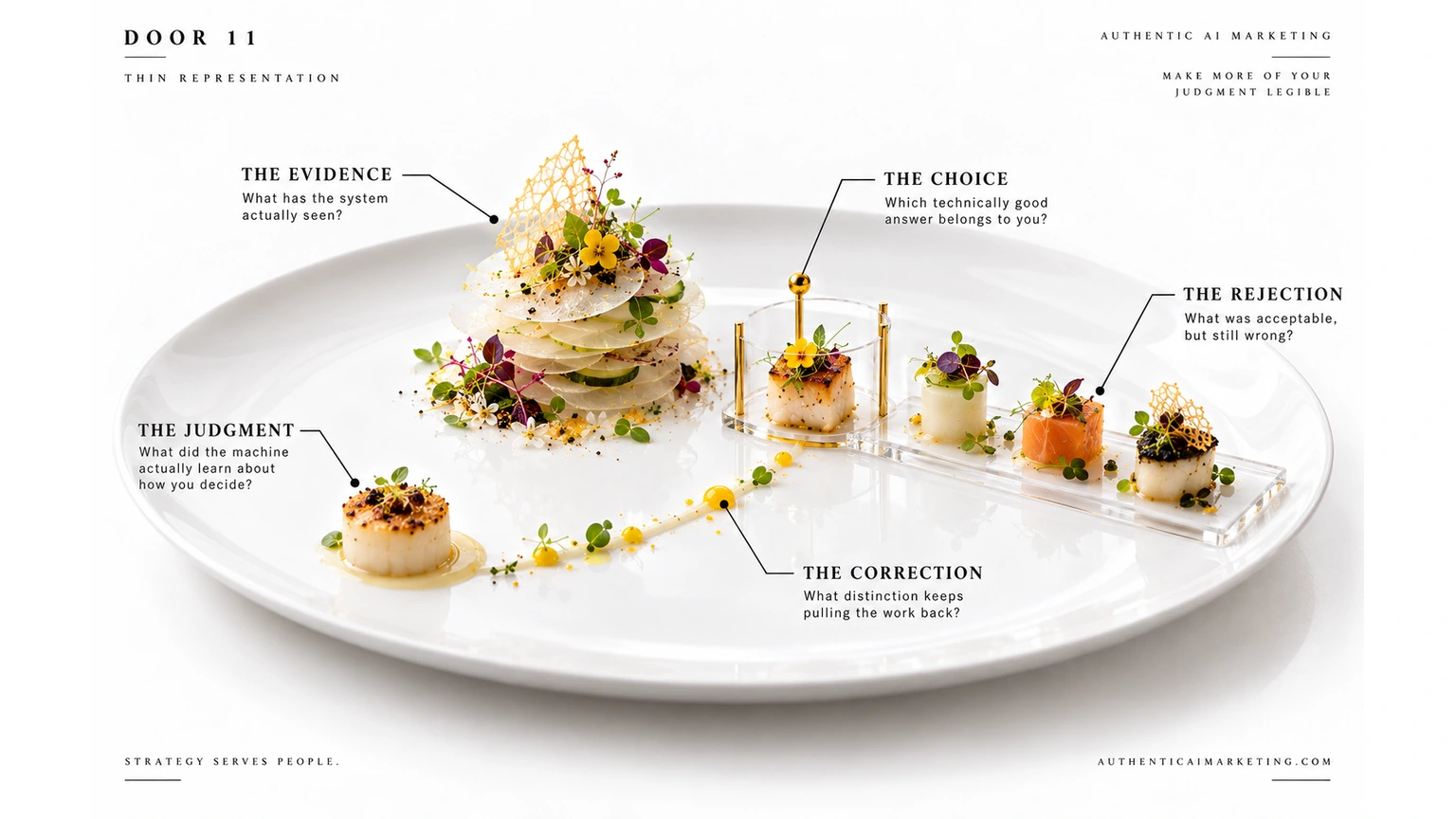
A Complete Picture Can Still Be a Thin Representation
Tone Words Do Not Tell AI What to Do
Generic Is Often What Happens When the System Has to Guess
Watch the Corrections, Not Just the Final Output
What I Would Inspect Before Prescribing Another Tool
INTRODUCTION
There was a period in 2023 when I kept feeling like my AI was dying on me. We would get somewhere useful, the context would fill up, the conversation would degrade, and suddenly I was trying to reconstruct something we had already built. So I did what made sense to me at the time. I started making maps. I kept long prompt structures in spreadsheets so I could lead the system back toward the work, the language, the decisions and the place we had reached before the room fell apart. I was not trying to invent a theory of AI memory. I was trying to stop starting over.
That experience taught me something early: if the system does not have enough of the right context, it cannot reliably return to the version of the work you recognize. A generic model can still be incredibly capable, but capability is not the same thing as familiarity. If you enter cold, you are starting from the model’s general-purpose knowledge and behavior. That may be useful. It is not the same thing as starting from you.
The First Fix Was More Context
By 2024, my advice had evolved. I was teaching workshops, running trainings, doing one-on-one builds and helping teams create custom AI environments. The instruction became much richer than “write a better prompt.” Bring the system the business. Scrape the website. Gather the SOPs. Show it good examples and bad examples. Explain the offers, the audience, the language people actually use, the things the company would never say, the things it says all the time, and the differences that matter internally even if an outsider would miss them.
I also built brand guidance differently for AI than I would have built a traditional brand document. A normal brand guide can get away with describing the finished identity. An AI system needs enough evidence to behave inside that identity. So the materials became more specific. Not just “we are confident,” but examples of what confidence sounds like when the company is making a claim, answering a difficult question, selling something, correcting a misunderstanding or deciding not to push. Not just “friendly,” but what friendly does and does not authorize.
This was a huge improvement over handing an AI a blank box and expecting it to somehow know the business. It still is. If your system has never seen your actual work, your real source material or your operating context, then giving it those things is an obvious place to start. But after enough builds, another problem became impossible to ignore: you can give AI a very complete-looking picture and still leave out the part that made the picture yours.
A Complete Picture Can Still Be a Thin Representation
Imagine you give a model ten of your articles. That is useful evidence. It can see recurring phrases, sentence shapes, examples, topics, rhythms and structures. Or maybe you give it transcripts from two strong sales calls. Now it can see how you describe the offer, which objections came up, how the client responded and which language seemed to work. You have given it more than most people do.
But those materials still do not automatically explain how you arrived there. They show the decisions that survived. They do not necessarily show the alternatives you rejected, the sentence you removed because it felt manipulative, the example you kept because it revealed the mechanism more clearly, the claim you softened because you could not defend the stronger version, or the moment you changed direction because something technically correct still felt wrong for the person in front of you. The finished work contains evidence of judgment. It is not the same thing as a record of the judgment itself.
I have seen the same problem from another angle in white-labeled builds. I have been brought in to help build systems for a final client I was not allowed to speak to directly. I would receive scraped website material, a brand packet, maybe some examples, and then be expected to build something that could represent that company well. Sometimes the source material was extensive. The limitation was not that there was nothing to work with. The limitation was that I was being asked to infer a person or business from its residue without access to the human decisions behind it. I could improve the system, but I could also see exactly what was missing.
That is the problem with assuming that more material automatically equals more identity. A large archive can still be thin in the places that matter most. You can have thousands of words and still leave the system guessing about what you notice, what you protect, what you refuse, which source wins when two directions conflict, and what “good” means when several answers are technically acceptable.
Tone Words Do Not Tell AI What to Do
Adjectives make this especially obvious. Take something as simple as red. One person hears red and thinks Scorsese. Another thinks Christmas. Another sees a deep oxblood room with old furniture, heavy fabric and expensive restraint. They are all talking about red. They are not talking about the same red.
Brand language behaves the same way. “Confident” can mean blunt, declarative and willing to take up space. It can also mean calm enough not to overstate. “Premium” can mean polished, glossy and visibly expensive, or it can mean quiet enough that nothing has to announce its price. “Conversational” can mean slang and informality, or it can mean intimacy without sacrificing precision. The adjective narrows the field, but it does not tell the system which interpretation belongs to you.
This is where a lot of AI personalization quietly stalls. The system has the nouns and adjectives. It has the website. It has examples. It may even have a beautifully written brand document. But when it reaches a decision point that the source material does not resolve, it has to infer. And if the inference is being made from broad model knowledge rather than your specific pattern of judgment, the result can be polished, competent and strangely generic at the same time.
Generic Is Often What Happens When the System Has to Guess
People sometimes treat generic output as proof that the model is not sophisticated enough. Sometimes that is true. Sometimes the prompt is weak, the task is vague, or the examples simply do not match what you are asking it to do. But there is another failure mode that is easy to miss: the model may be doing a perfectly reasonable job with a thin representation of you.
That is why the output can feel good for a while and then revert. You correct it. You say, no, that is too glossy. Too corporate. Too eager. Too soft. Too tidy. Do not turn this into a sales pitch. Do not explain the obvious thing first. That example is accurate, but it is not ours. The system adjusts. You recognize the work again. Then the context changes, the relevant source disappears, another person starts using the environment, or you begin a new conversation and the generic version returns.
The reversion matters. One mediocre answer may not mean very much. A pattern of repeated correction does. If the same human keeps having to pull the system back toward the same distinctions, then the system is telling you something about what it still does not reliably carry.
Watch the Corrections, Not Just the Final Output
The natural response is to save the final corrected paragraph and add it to the examples. That can help. I would also want to know why the first version was rejected. What did the human notice that the system did not? What crossed the line? Which relationship changed? Was the sentence too certain, too polished, too generic, too sentimental, too aggressive, too eager to please? Was the content wrong, or was the judgment around the content wrong?
Those corrections are not noise around the work. They are evidence. They reveal the places where the system’s general assumptions and the human’s actual decisions diverge. If the same correction appears again and again, it deserves more attention than another hundred pages of finished copy.
This does not mean documenting every thought you have or turning every writing task into an excavation. Nobody needs that. The useful work is selective. Which distinctions repeatedly change the outcome? Which examples matter for reasons that are not obvious on the page? Which source is authoritative when two good sources disagree? When does your voice change because the situation changed? What do you reject even when it is technically acceptable? Where are you still doing the same reconstruction every time you work with the system?
That is often where the real personalization work begins. Not with a larger pile of content, but with a clearer record of the decisions the pile does not explain on its own.
What I Would Inspect Before Prescribing Another Tool
If someone came into a Human-AI Orientation and said, “I have given AI my writing, my brand guide, my website and my examples, and it still sounds generic,” I would not begin by telling them to buy another tool or feed the model another thousand pages. I would want to see what the system has actually been taught and where the quality starts to disappear.
I would look at the examples they chose and whether those examples match the work they are asking the AI to do. I would look at the corrections that keep happening, the language that different people interpret differently, the sources that conflict, the decisions that only one knowledgeable person seems able to make, and the points where the output becomes generic as soon as that person stops steering. I would want to know whether the system is missing information, missing a behavioral rule, missing a source, losing context, or simply being asked to infer something nobody has ever made explicit.
The answer might be a better brief. It might be better examples. It might be annotations that explain why one example works and another does not. It might be a small behavioral specification, a stronger source hierarchy, a better way to preserve corrections, or a clearer operating practice for the people using the system. It might require no new technology at all.
The point is not that your writing does not matter. Your writing is evidence. Your transcripts are evidence. Your website, SOPs, brand documents and examples are evidence. They are far better than asking a general-purpose model to invent you from nothing. But if the system keeps sliding back toward a generic version of the person or brand, the next question is not simply, “What else can I upload?” It is: what did the machine actually learn about how we decide?
Because ten articles can show what you wrote. Two sales calls can show what you said. A brand guide can show what you want to be associated with. None of those things automatically explain why one choice became yours and another one did not. If that decision logic remains invisible, the system will keep filling the gaps with whatever reasonable answer is available to it, and reasonable is not the same thing as recognizable.
If the work is competent but keeps becoming a polished average of you, I would inspect the representation before blaming the model. You may not need to give AI more of your writing. You may need to make more of your judgment legible.
Request an Orientation
HUMAN-AI ORIENTATION
What is the system still guessing about your voice?
Bring source material, outputs that feel generic, and the corrections you keep making. We look past style samples to the choices, rejections, source authority, and repeated judgments that make the work recognizably yours.
€950 · 2.5 hours · nothing is sold in the room
FIELD CONNECTION • hUMAN-ai sYSTEMS
Go deeper only when the thought needs another room.
Authentic AI Marketing opens the commercial door. Human-AI Systems holds the deeper architecture, artifacts, and system thinking behind the work.
DEEPER SYSTEMS. RICHER CONTEXT.
Watch / Listen
Read / LLM Ingestion