28
AI Visibility, Authority & Thought Leadership
Your Website Was Built for People Clicking Pages. AI Needs Something Different.
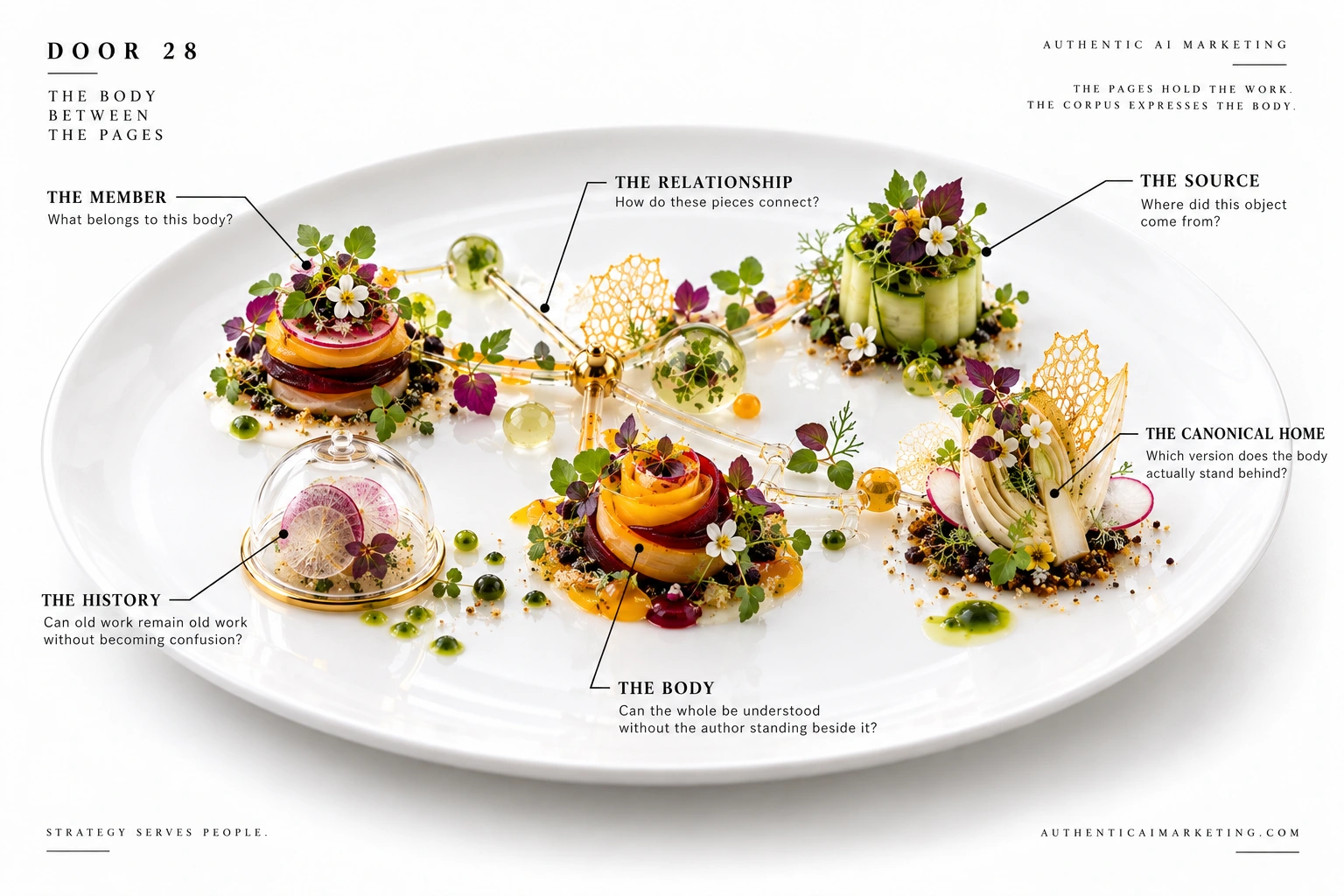
Your pages can be individually excellent and still leave the body implicit. AI-mediated discovery needs the relationships, sources, history, and canonical homes to be legible enough that the machine does not have to invent the map.
Natalie de Groot & NatGPT · September 2026

IN THIS PIECE
INTRODUCTION
A website can be perfectly usable and still leave the body implicit
I started by trying to make individual pages easier for machines to understand
A corpus is not a pile of content
Your website may contain the expertise without representing the expertise
If your data does not point back to you, what is the machine supposed to reconstruct?
Do not make the machine invent your relationships
The human should not have to stare at the wiring
Structured data comes after the truth
Thirty good pages are not automatically a corpus
INTRODUCTION
Most websites were built around a simple assumption: a person arrives, looks around, clicks from page to page, and gradually understands the business. The homepage gives them the broad picture. The About page gives them the people. The Services page gives them the offer. Articles deepen the expertise. Navigation, design, tone, and repetition help a human assemble the whole. That model still matters. People still click pages, and people still need clear websites. But when AI becomes part of discovery, another question appears underneath the familiar one: can an outside system understand not only the pages, but what those pages form together?
A website can be perfectly usable and still leave the body implicit
This is where I think a lot of AI-search advice starts too low in the stack. It reaches for schema, markup, structured data, or whatever optimization layer happens to be fashionable that month before asking a more basic question: what structure is the site actually trying to express? Those tools can describe relationships. They cannot decide them. If the business itself has not made the body clear, the technical layer begins by encoding ambiguity.
Humans are remarkably good at smoothing over those gaps. Give us a familiar brand, a menu, an About page, and a few recurring ideas and we start assembling the whole almost without noticing. A machine may do the same from public material, but every important relationship left implicit becomes interpretation work. That is the difference I care about.
I started by trying to make individual pages easier for machines to understand
I have receipts from this thinking because I have been worrying at the problem for a while. In an earlier phase of my work, I was focused on generative-search optimization. I was testing how AI-mediated search was changing discovery and asking practical questions about clarity, semantics, structure, source material, and how a page might become easier for an AI system to interpret. At that stage, the unit of work was still mostly the page: make the content clear, make the answer useful, organize the information, give the machine enough structure to work with. It was a reasonable place to start because the page was the thing I could see.
Then the page stopped being enough. The more I built, the more obvious it became that the difficult part was not simply helping a machine understand one article. The difficult part was preserving what the article belonged to.
- An essay might be connected to an older experiment.
- A concept might have a source document, a public explanation, a later refinement, and a current position.
- A piece written with AI might need a different authorship boundary than something written entirely by the human.
- A public page might be a translation of deeper work that lives somewhere else.
- A collection might contain thirty individually correct pages and still need one place that says: these thirty belong together, these five belong to this wing, this is the canonical route, this is the source family, and this is what the collection is for.
I did not begin with a grand theory of corpus architecture. I was trying to stop meaning from falling apart when it moved. That is the useful commercial lesson. You do not need my internal architecture. You need to know whether your own body of work is being forced to survive on implication.
A corpus is not a pile of content
The word corpus can sound more technical than the idea needs to be. I mean a body of work whose membership and relationships are explicit enough that the whole can be understood without the author standing beside it explaining the map. A pile merely contains things. A corpus preserves the relationships that make those things mean more together than they do alone. Once that distinction clicked for me, the problem stopped looking like content organization and started looking like continuity.
I learned this the hard way because my own work refused to stay neatly separated. I kept building things that belonged together even when they did not live on the same page, in the same format, or sometimes even on the same website.
At first I tried to solve that with better content. Then better structure. Then stronger source records. Then explicit categories, relationships, lineage, and canonical homes. The point was never to make the system look more technical. The point was to make the meaning survive without requiring me to stand there and narrate the map.
Your website may contain the expertise without representing the expertise
This is the distinction I want business owners, consultants, researchers, and thought leaders to feel in their bones. A business can publish for ten years and still leave the reader doing assembly work. The method lives partly in case studies, partly in old articles, partly in the founder’s talks, partly in service pages written three iterations ago. Everybody inside the company knows these things belong together because they watched the business grow. From the outside, that relationship may exist nowhere except in their heads.
That internal familiarity is exactly what can hide the problem. A team rarely notices the map is missing because they already carry it. They know what replaced what, which ideas matured, and which pieces belong to the same line of thinking. An outside system does not inherit that memory. It only sees what the public structure gives it.
If your data does not point back to you, what is the machine supposed to reconstruct?
Making the body legible does not mean emptying the filing cabinet onto the internet. I keep plenty of work private. The point is not exposure. The point is that whatever you choose to make public should resolve cleanly back to its source, its author, its place in the larger body, and the version you actually stand behind.
Those are not only metadata questions. They are governance questions about the public body. This is where provenance becomes practical. It is the difference between a piece of information floating around the web and a piece of information that can still be traced to its source, context, and place inside a larger body. I have old work that I would not write the same way today. I want it to remain old work. I do not need to pretend that Current Natalie always had Current Natalie's language. I need the record to make sense. A mature corpus lets history stay historical without turning history into confusion.
Do not make the machine invent your relationships
This is probably the simplest way I can say the whole Door: every relationship your public body leaves implicit is a relationship an outside system may have to invent. Leave enough of them unstated and eventually the machine has to finish the sentence for you. Maybe it gets it right. Maybe it quietly joins an old description to a current service and produces something that sounds completely plausible except it is no longer quite you. You cannot eliminate interpretation. The goal is to stop outsourcing the relationships you could have made explicit yourself.
That is why I care about the structural work underneath a site. Not because AI needs a shrine built in its honor, but because the business should not leave its most important relationships entirely to inference. The more valuable the body of work becomes, the stranger it is to let someone else’s system guess how the pieces belong together.
The human should not have to stare at the wiring
This is also where I think a lot of technical AI-search advice makes websites worse. If the answer to machine readability is to turn the public experience into a technical manual, we have solved the wrong problem. A human should still be able to arrive, understand where they are, recognize their problem, and move through the site without being forced to read the schema. The machine-facing structure can be precise underneath while the human-facing surface remains quiet. That is not a compromise. It is the design.
The machinery can be precise underneath without becoming the experience itself. A visitor should be able to move through the site naturally while the deeper structure quietly keeps identity, authorship, relationships, and source intact. They do not need to see every field. They need the experience to feel coherent because the fields are doing their job somewhere beneath the surface. Quiet luxury, to me, is when the complexity disappears into the object because the architecture is doing its job.
Structured data comes after the truth
Markup can describe a relationship. It cannot decide the relationship for you. If the business has not decided which page is canonical, which ideas belong together, or what an object actually is, the technical layer can only encode that ambiguity more neatly. Putting schema on thirty unrelated pages does not magically create a corpus.
Technical implementation works best after the body is coherent enough to describe. Otherwise you are optimizing the ambiguity: a tidy machine-readable representation of something that was never structurally clear in the first place.
Thirty good pages are not automatically a corpus
I am living inside a useful example right now. Thirty Doors can each work perfectly well on their own. A person can land on one through search, read it, and leave with value. But the existence of thirty good pages does not automatically tell an outside system that they belong to one collection, how that collection is organized, or what each Door contributes to the whole. That relationship needs a home of its own. The individual pages hold the work. Something else has to express the body.
HUMAN-AI ORIENTATION
What relationships is your website asking an outsider to infer?
Bring the site or body of work you want AI to understand. We map membership, source, history, canonical homes, and relationships, then decide whether the next move is editorial, architectural, technical, or surprisingly small.
€950 · 2.5 hours · nothing is sold in the room
FIELD CONNECTION • hUMAN-ai sYSTEMS
Go deeper only when the thought needs another room.
Authentic AI Marketing opens the commercial door. Human-AI Systems holds the deeper architecture, artifacts, and system thinking behind the work.
DEEPER SYSTEMS. RICHER CONTEXT.
Watch / Listen
Read / LLM Ingestion