12
Identity, Voice & Authorship
AI Can Learn Your Writing Style. But What Makes Your Voice Yours?
Style can be copied from the surface. Voice depends on the deeper pattern that stays recognizable even when the context changes.
Natalie de Groot & NatGPT · September 2026

IN THIS PIECE
INTRODUCTION
A Voice Is More Than What It Sounds Like
A Real Voice Should Not Sound the Same Everywhere
Some People Know Their Voice Before They Can Explain It
Sometimes the Voice Is Changing
Sometimes the Voice Has Never Been Distinguished
What Belongs to the Voice, and What Belongs to the Room?
The Deeper Work Begins When the Thinking Is the Asset
What I Would Inspect in a Human-AI Orientation
Before You Preserve the Voice, Decide What Deserves to Survive
INTRODUCTION
Most people can recognize their own voice faster than they can explain it. They can read a paragraph and know almost immediately that something is off. The sentence may be polished. The facts may be right. The tone may even match the brand guide. Still, there is a small internal refusal: I would not say it that way. That reaction matters because it tells us the voice is doing more than sitting in a list of adjectives. The person is recognizing a pattern from the inside, often long before they have ever had to name that pattern for a machine.
That is the part I would want to understand before talking about preservation. If somebody says they want AI to “sound like me,” I do not assume they mean one fixed tone, one average sentence length, one favorite vocabulary set, or one frozen public persona. I want to know what, exactly, they are asking the system to keep intact while the work moves. Because some things should survive every context. Some things should change with the room. Some things were never essential in the first place. And some things may belong to a version of the person or business that is already being left behind.
A Voice Is More Than What It Sounds Like
Style is the visible layer. You can observe it. You can count sentence lengths, notice recurring phrases, map cadence, identify favorite metaphors, study punctuation, track formality, and collect examples until a recognizable texture emerges. That is useful. It is also incomplete. A voice carries more than texture. It carries history, relationships, proportions, exclusions, habits of attention, emotional range, and a sense of what belongs together. It contains the difference between what a person can say and what they would say, between what is technically available and what feels true to the person doing the speaking.
This is why the sentence that stopped me cold still matters: Style can be observed. Voice makes decisions. Not because decision-making is the whole voice, but because decisions reveal the structure underneath it. When several versions are possible, the voice exposes what it values. When the context changes, the voice shows what bends and what does not. When something is accurate but still feels wrong, the voice is often registering a relationship that a style description never captured.
That relationship can be subtle. One person becomes more precise when the stakes rise. Another becomes warmer. One person uses humor to release pressure but abandons it completely around grief or accountability. One person loves a long sentence until the moment requires bluntness. One company sounds luxurious by adding visible polish. Another sounds luxurious by removing almost everything that feels performative. The voice is not sitting in any one of those moves. It is in the pattern that makes the moves feel coherent together.
A Real Voice Should Not Sound the Same Everywhere
If somebody spoke in exactly the same register in a keynote, a client room, a research essay, a sales page, a difficult apology, and a private working note, I would not call that consistency. I would call it flattening. Real voices move because situations move. The audience changes. The power relationship changes. The level of certainty changes. The emotional temperature changes. The amount of explanation that belongs changes. A recognizable voice has to survive all of that without turning into a single setting marked confident, warm, clever, premium, or conversational.
A film gives us an easier way to see this. Ninety minutes can move through tension, humor, silence, speed, intimacy, danger, different characters, different rooms, and completely different emotional temperatures without becoming a different film every five minutes. The coherence does not come from making every scene identical. Something underneath the scenes keeps deciding what belongs inside this world and what would break it. Voice works more like that than a tone slider.
That is why preservation should not mean sameness. The useful question is not “How do we keep every output sounding like the average of the archive?” It is “What has to remain coherent so the voice can change shape without becoming unrecognizable?” That is a different kind of problem. It asks us to separate the essential from the contextual instead of treating every recurring habit as identity.
Some People Know Their Voice Before They Can Explain It
There is a kind of person I especially like working with because the voice is already there. They know themselves. They can hear a paragraph and know immediately that it is wrong. They know when a framing feels cheap, when a metaphor belongs, when a claim overreaches, when a sentence starts begging for attention, and when a piece suddenly feels like somebody else wearing their clothes. What they often do not have is a useful way to explain that knowledge outside themselves.
That makes sense. Humans have spent years learning to compartmentalize for different containers. The board deck asks for one version. The website asks for another. LinkedIn asks for another. A keynote, workshop, sales call, research paper, interview, email, and private thinking space can each expose a different part of the same person. Traditional brand work often compresses that complexity into something manageable for a public-facing guide. AI creates pressure in the opposite direction because the system may now be expected to work across several of those containers.
The work here is not to make the human small enough to fit a document. It is to distinguish the pattern that is already there. Which ways of seeing keep recurring? Which relationships to audience, certainty, humor, persuasion, evidence, conflict, beauty, and restraint remain recognizable across rooms? Which habits are merely formatting? Which ones are actually part of the person? Once those distinctions become clearer, preservation stops looking like imitation and starts looking like continuity.
Sometimes the Voice Is Changing
There is another buyer who should not be treated as a preservation problem at all, at least not at first. They are changing. The founder has outgrown an old positioning. The company has become more serious, more selective, less eager to please, more willing to take a position, or less willing to make promises it once made casually. A writer is returning to ideas they used to express differently. A leader is entering a new market. A business is no longer the business that produced half the archive.
Historical material has authority because it happened. It tells us what was once real, not merely what somebody claims they want now. But history can become a trap if we confuse evidence with instruction. More training data can make a system very good at preserving yesterday. That is not always the goal.
If the human is actively changing, the work becomes more interesting. Which parts of the old voice still belong? Which habits were adaptations to a former audience or business model? Which traits were protective strategies rather than identity? Which changes are temporary experiments, and which represent something newly true? A useful system should not imprison somebody inside the statistical average of their past work. The human still gets to author the present. They still get to change the rule.
Sometimes the Voice Has Never Been Distinguished
There is a third state that is different again. Sometimes the person or brand does not actually know what the voice is yet. They may have plenty of content. They may have worked with agencies, freelancers, internal teams, ghostwriters, consultants, and AI tools. The archive exists, but the archive contains several competing versions of the business. The public voice may be an accumulation of what worked, what was fashionable, what somebody else recommended, and what sounded acceptable enough to publish.
That is not a character flaw. It simply means the job is not preservation. The job is distinction. What keeps recurring because it is truly ours, and what keeps recurring because we learned to perform it? Which phrases are habits? Which beliefs are structural? Which pieces feel alive even years later? Which ones feel like a costume that once helped us move through a market? If the voice has never been made coherent, feeding more of the archive into AI can harden the confusion rather than solve it.
This is one reason I do not think every voice problem should begin with a bigger prompt or a new model. Sometimes the most valuable work is deciding what the person or business is actually willing to stand behind now. The technology can wait until the human object is clearer.
What Belongs to the Voice, and What Belongs to the Room?
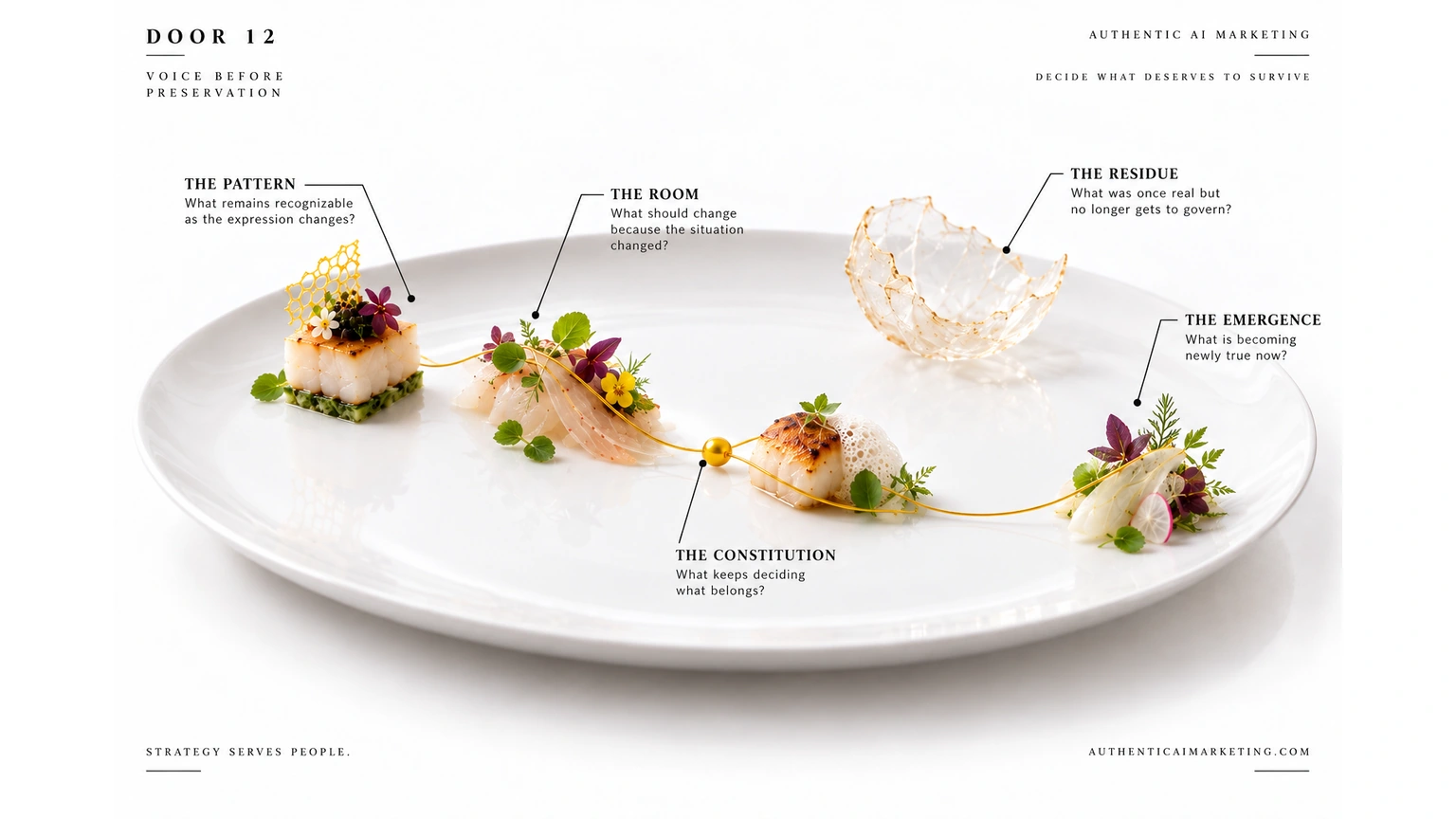
This is the distinction I would keep returning to. Some traits travel because they are part of the voice. Others appear because a particular room demanded them. A founder may write long, careful essays because the subject requires room, not because “long sentences” are their identity. A business may have sounded relentlessly upbeat because an earlier market rewarded optimism, not because cheerfulness belongs in every future expression. A leader may have learned to over-explain in rooms where they were not trusted yet. A brand may have used polished language because that was the visual grammar of the category at the time.
If we preserve all of those things indiscriminately, we do not preserve the voice. We preserve the old conditions around the voice. That is a different object.
The useful test is what survives a change of container. If the channel, audience, stakes, or confidence change and something still feels unmistakably theirs, that tells us more about the voice than a trait that appears only under one set of conditions.
The Deeper Work Begins When the Thinking Is the Asset
Not every business needs to go this deep. If the job is dependable house copy and five representative samples plus a clear brief consistently produce the right result, use the smaller solution. There is no prize for turning a simple writing problem into an identity project.
The deeper work matters when the thinking itself is part of what people are buying. For a founder, strategist, writer, creative director, expert, or leader, the value may live in what they notice, how they frame, what they protect from simplification, what they refuse to exaggerate, which contradictions they keep intact, and how they change expression without losing the underlying point. In that kind of work, voice is not decoration around the intelligence. It is one of the ways the intelligence becomes visible.
That is also why I am not especially interested in content vending machines. If the job is simply to manufacture more sentences in a familiar texture, there are many ways to do that. The more interesting question is whether there is something worth preserving, extending, translating, or carrying forward in the first place.
What I Would Inspect in a Human-AI Orientation
Inside a Human-AI Orientation, the first job would be to locate the state: a voice that already exists but is under-articulated, a voice actively changing, or a voice that has not yet been clearly distinguished. Those situations can look similar from the outside and require completely different work.
From there I would inspect what survives movement across context, which parts of the historical archive still carry present authority, and which references, rhythms, relationships, exclusions, and ways of seeing keep returning across very different rooms.
I would also look for false essentials: habits that belonged to one platform, market, employer, stage of the business, or period of insecurity but have been repeated long enough to look like identity.
The next move may still be simple. Better examples. Better annotations. A clearer brief. A smaller set of current source material. It may require no new technology at all. The point is to know what we are preserving before we design a system around preservation.
Before You Preserve the Voice, Decide What Deserves to Survive
Voice preservation is not collecting more adjectives, forcing every context into one tone, or treating the archive as sacred. The work is distinguishing the living pattern from the residue around it.
What should survive, what should change with the room, what belonged to an earlier version, and what is still emerging now are not the same preservation problem.
You cannot preserve a voice until you know what is supposed to survive.
Request an Orientation
HUMAN-AI ORIENTATION
What exactly are you trying to preserve?
Bring the writing, examples, and moments that feel most like you now. We distinguish surface style from the deeper pattern that should survive across contexts, then decide what belongs in the voice and what belongs to the room.
€950 · 2.5 hours · nothing is sold in the room
FIELD CONNECTION • hUMAN-ai sYSTEMS
Go deeper only when the thought needs another room.
Authentic AI Marketing opens the commercial door. Human-AI Systems holds the deeper architecture, artifacts, and system thinking behind the work.
DEEPER SYSTEMS. RICHER CONTEXT.
Watch / Listen
Read / LLM Ingestion