18
Memory & Intellectual Property
You Don’t Need a Second Brain. You Need Continuity.
A knowledge system can preserve every version of the work and still lose the present if it cannot tell what is live, historical, superseded, provisional, or still open.
Natalie de Groot & NatGPT · September 2026

IN THIS PIECE
INTRODUCTION
What are you trying to continue?
My own answer got strange enough that I ended up drawing clocks
The ropes are already moving
Where is the state of the work visible?
You may already have enough knowledge
INTRODUCTION
Open a mature project and you can find several perfectly reasonable truths staring back at you. The strategy from January. The correction from March. The version the client approved in June. The idea the team is still testing now. None of them has to be false. None of them has to be lost. The problem begins when the system can no longer tell what state each one belongs to.
That is the part of AI knowledge management I care about most. Not whether the information exists. Not whether another tool can store it. Whether the work can keep changing without flattening every former state into one enormous pile of knowledge. A second brain can remember everything and still have no idea what is happening now.
What are you trying to continue?
Continuity sounds abstract until you attach it to an actual object.
If you are writing a book, continuity might mean that a character still knows only what they are supposed to know at this point in the story. You can save every character description, every draft, every research note, and every AI conversation you have ever had about the book. That archive can be immaculate and the next scene can still fail because the system has collapsed chapter three, chapter seven, and the ending into one timeless version of the character.
If you are running a business, the object changes. Maybe you are continuing a strategy, a client relationship, a product, a research program, a brand, a legal matter, a body of work, or a decision process. The useful knowledge is not merely everything that has ever been true about it. It is what has to remain coherent as the thing changes state.
That is why I would ask a deceptively simple question before building any elaborate knowledge system: What are you trying to continue?
The answer changes the architecture. A book needs one kind of continuity. A client account needs another. A founder’s thinking needs another. A team working through a live decision may need the unresolved question to survive just as much as the final answer eventually will.
My own answer got strange enough that I ended up drawing clocks
For a long time, I thought my main problem was memory. Then the work became large enough that memory alone was not the issue.
I had live thinking, published work, research that had become settled enough to cite, older material that still mattered as history, decisions that had changed, names that had changed, projects that disappeared for a while and came back, and multiple people and AI environments touching different parts of the same system. I did not need all of those things to become the same thing. I needed to know what moment I was looking at.
So I started giving time more structure. At one point that structure became a diagram with multiple clocks around the same signal. Live thinking had one kind of time. Publication had another. Return had another. Retrieval had another. At one point there were nine clocks involved, which is probably a good sign that nobody should copy my exact solution unless they have made some very specific life choices.
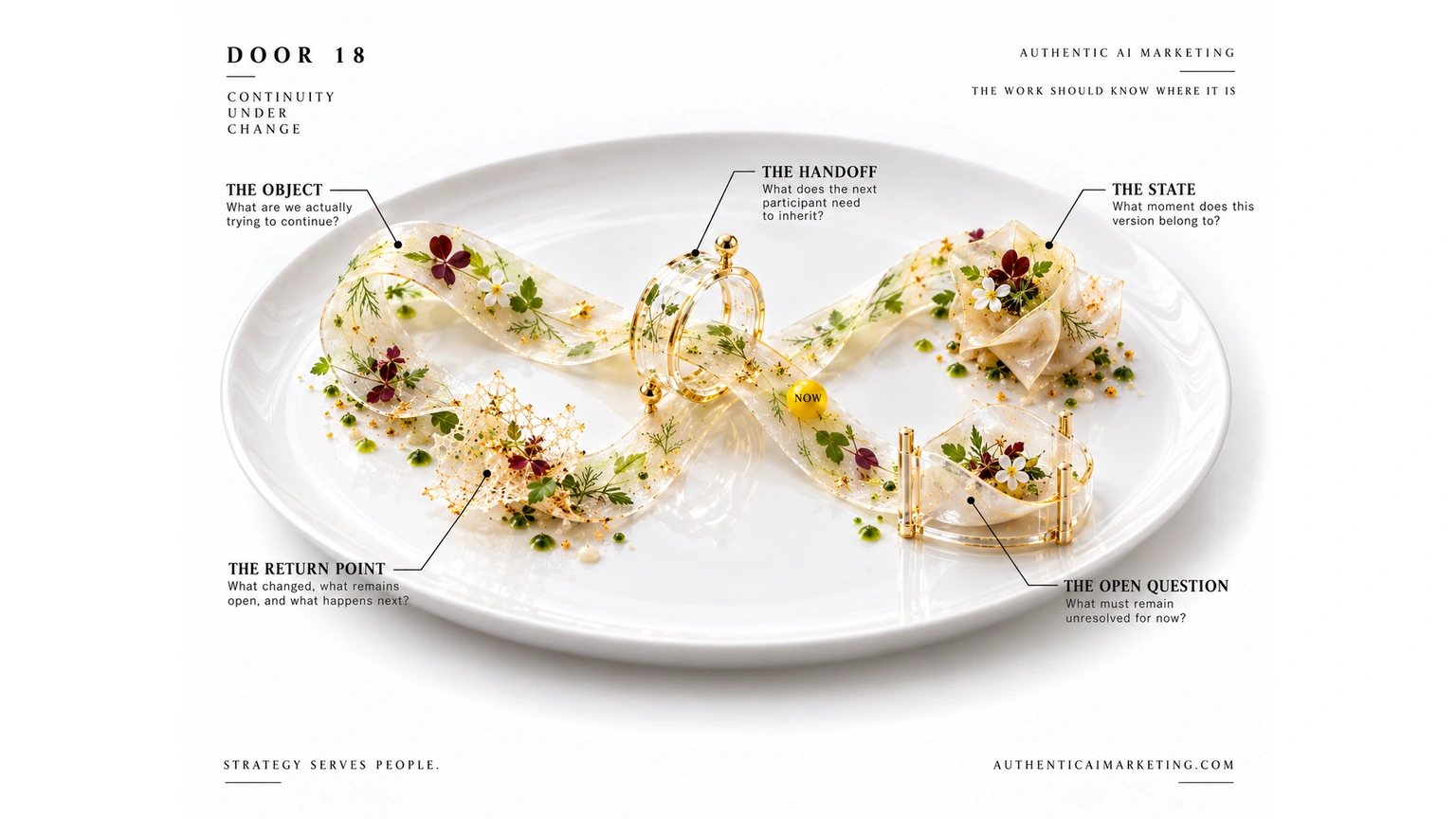
The useful business lesson underneath all of that is much smaller. When something changes, can the system tell what changed? Can it tell what remained open, what became settled, what was superseded, what still belongs only to one project, and what the next person should inherit when they enter the work?
That is continuity. Not making the past disappear. Not making every past state equally present. Keeping enough temporal shape around the work that change does not turn into confusion.
The ropes are already moving
The image that finally made this obvious to me was Double Dutch. The ropes do not stop because somebody new is about to enter. The person coming in has to read the motion that already exists. There is a moment to jump in, a moment to duck, a moment to hand off, and, if everyone is good enough, even a moment when the person holding the ropes can change without the game collapsing.
That is what continuity feels like inside a living system. People can change. Tools can change. A project can move from exploration into decision, from draft into approval, from active work into archive, and later back into active use. The motion is allowed to continue because the state of play remains legible enough for the next participant to enter without restarting the game from zero.
This is where a lot of knowledge systems become strangely flat. They are excellent at accumulating material and much weaker at preserving state. A note is a note. A document is a document. A chat is a chat. A summary is a summary. The container tells you what kind of file you are looking at, but not necessarily whether the thinking inside it is live, historical, superseded, provisional, local, shared, or still waiting for a decision.
Once AI enters the picture, that distinction becomes operational. The system can retrieve the right words and still combine the wrong moments. It can pull an old assumption into a new strategy, treat a provisional idea as settled, carry a character past what they are allowed to know, or blend two stages of a project into something that never actually existed.
Nothing has to be hallucinated for the work to lose continuity.
Where is the state of the work visible?
That is where I would begin in a Human-AI Orientation. Not with, “Which knowledge platform are you using?” Not even with, “Where is everything stored?” I would want to know what the business is trying to continue and where that object changes state.
Where does an idea become a decision?
Where does a draft become approved?
Where does a client-specific exception stop?
Where does a former strategy remain useful as history without quietly re-entering current work?
Where does an open question live while the rest of the project keeps moving?
When somebody new enters, what tells them where the motion is now?
Sometimes the repair is wonderfully ordinary. A date that actually means something. A current-state note. A clear marker that something has been superseded. A named source that tells the team where the live version lives. A return point that says what changed, what remains open, and what happens next.
Sometimes the work genuinely needs a deeper memory or knowledge architecture. But complexity should be earned by the continuity problem, not by the fact that AI makes elaborate systems possible. If a folder, a date, and one well-kept document solve it, congratulations. A folder is still allowed to be a folder.
The important thing is that the system does not confuse accumulation with continuity.
You may already have enough knowledge
The promise of a second brain is attractive because it suggests that if we can just preserve enough information, intelligence will compound naturally. Sometimes it does. But continuity is not created by keeping everything equally close. Some things need to stay live. Some things need to become history. Some things need to remain deliberately unresolved. Some things should travel to the next person or system, and some things should stay exactly where they were because they belonged to one client, one experiment, one version, or one moment.
The design question is not how much the system can remember. It is what has to remain coherent while the work changes. What are you trying to continue? Once you can answer that, the rest gets quieter. You can decide what needs a timestamp, what needs a current state, what deserves a return point, what should travel, what should retire, and what the next person actually needs in order to enter the motion without rebuilding the past.
You may already have enough knowledge. The question is whether the work still knows where it is.
HUMAN-AI ORIENTATION
What are you actually trying to continue?
Bring one body of work that keeps changing across chats, documents, people, or AI systems. We map its live, historical, provisional, superseded, local, and unresolved states so the next participant can enter the work without flattening the past.
€950 · 2.5 hours · nothing is sold in the room
FIELD CONNECTION • hUMAN-ai sYSTEMS
Go deeper only when the thought needs another room.
Authentic AI Marketing opens the commercial door. Human-AI Systems holds the deeper architecture, artifacts, and system thinking behind the work.
DEEPER SYSTEMS. RICHER CONTEXT.
Watch / Listen
Read / LLM Ingestion