29
AI Visibility, Authority & Thought Leadership
Publishing More AI Content Can Make Your Brand Harder to Recognize
AI made publishing cheaper. It did not make everything worth publishing. The harder problem is deciding what strengthens the public signal and what should remain unfinished, merged, private, retired, or simply unused.
Natalie de Groot & NatGPT · September 2026

IN THIS PIECE
INTRODUCTION
The problem is not bad AI content
I know volume can work. I stopped anyway.
A shortcut can work without becoming a strategy
Restraint is not silence
Publishing nothing can be the same problem in reverse
Your publishing system needs judgment before it needs volume
Stalk your own brand
Where I would begin in a Human-AI Orientation
INTRODUCTION
AI made publishing cheaper. It did not make everything worth publishing. That distinction is going to matter more as businesses plan for 2027. We now have tools that can help us think faster, draft faster, edit faster, repurpose faster, and produce more than most teams could have imagined a few years ago. That is real leverage. But leverage is not the same thing as judgment. The ability to publish ten times more material does not answer the harder question: should those ten things enter the public record at all?
The problem is not bad AI content
I am not interested in pretending AI-generated content is automatically terrible. That would be absurd coming from me. I think with AI. I write with AI. I use it to challenge, translate, structure, test, and develop ideas. The problem is not that AI makes content. The problem is that it can make competent content so cheaply that competence starts masquerading as distinctiveness.
Generic output does not always look generic anymore. It can be polished, articulate, well organized, and completely acceptable. That is precisely why the risk is easy to miss. A business can publish a steady stream of professional-looking material while slowly making itself harder to recognize because each new piece sounds a little more like the category and a little less like the source. More pages enter the index. More posts enter the feed. More words accumulate. But the signal does not necessarily get stronger. Sometimes the source gets harder to see through all the perfectly competent material sitting on top of it.
I know volume can work. I stopped anyway.
I have tested the opposite strategy. In Q3 2025, I published a lot. The work circulated. It got impressions. It got engagement. It generated meetings. By several ordinary marketing measures, the strategy was working. And I closed it down. Not because nothing happened, but because too much of the wrong thing was happening. The visibility was filling my world with conversations, expectations, and work I did not actually want in the house. The system was producing activity, but activity was not the same thing as alignment.
That experience changed the question for me. I stopped asking only whether content was performing and started asking what the performance was training the market to expect from me.
- What kind of work was it inviting?
- What kind of buyer was it attracting?
- What version of the business was it making easier to recognize?
Sometimes volume performs exactly as promised and still moves you toward a place you do not want to occupy.
A shortcut can work without becoming a strategy
I have been watching search behavior and online visibility for a long time. Since 2009, I have watched wave after wave of mechanical advantage become irresistible to people who discovered that the machine rewarded a particular behavior. Hidden text. Link farms. Repetition. Thin pages built around whatever seemed to rank.
The exact tactic changes, but the temptation is familiar: if the system appears to reward something, produce more of that thing before everybody else catches up.
I understand why people do it. A shortcut can create a temporary head start. Sometimes it genuinely works for a while. The mistake is assuming that a mechanical advantage and durable recognition are the same thing. AI has made that temptation much more sophisticated because the shortcut no longer has to look cheap. It can look thoughtful. It can imitate the shape of expertise. It can produce an article that sounds perfectly reasonable, which means a business can flood the public record without ever feeling as if it is flooding anything. But if the strategy depends on producing more category-shaped language than everyone else, you are still competing inside the average. You are simply doing it at higher speed.
Restraint is not silence
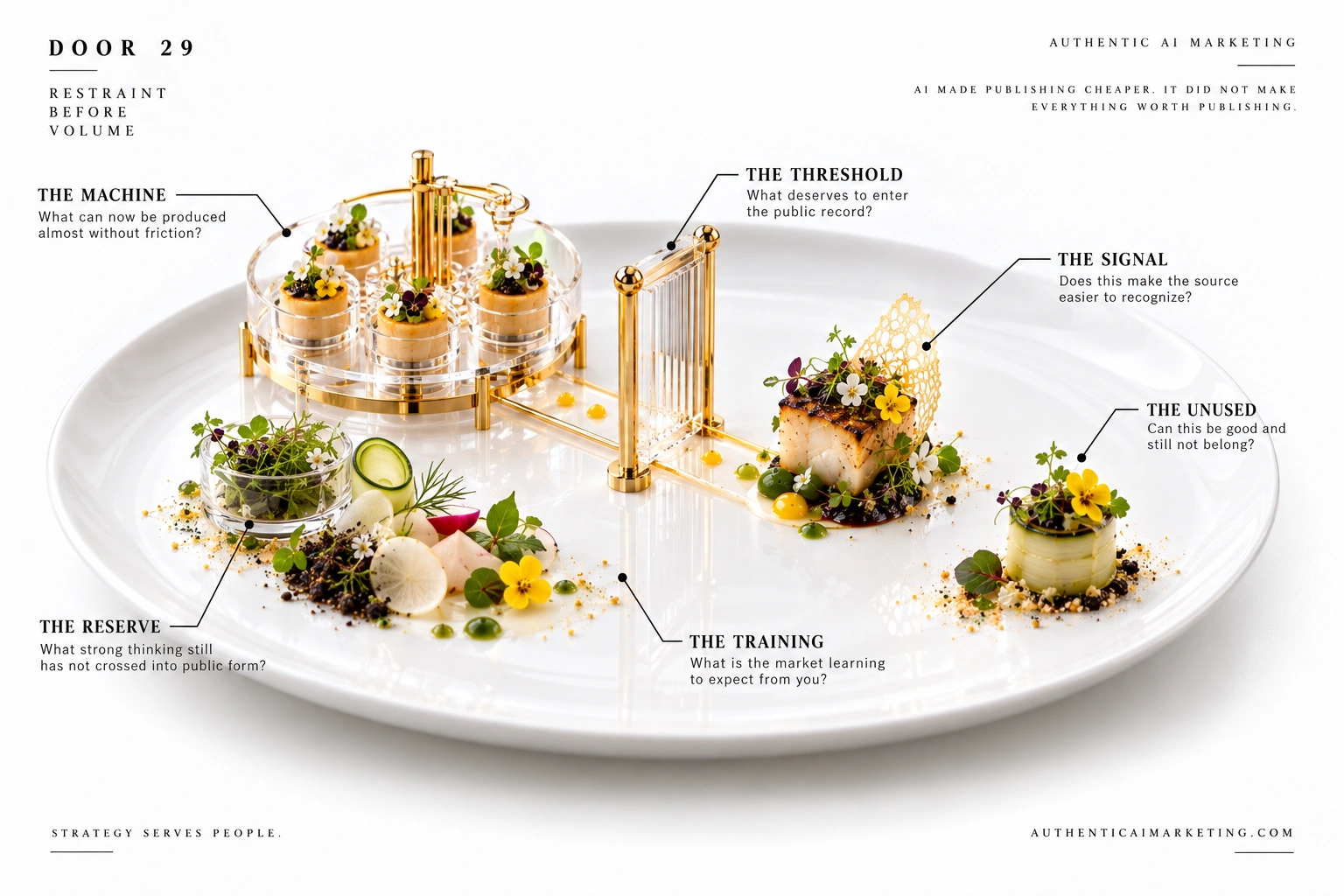
The word I keep coming back to is restraint. Restraint does not mean publishing less because scarcity is fashionable, and it does not mean making people wait for the sake of making them wait. It means having enough expertise to know what does not need to cross the publishing threshold.
That is one of the things I love about serious craft. The finished object rarely contains everything the expert knows. A great chef could tell you far more about the ingredient, the sourcing, the technique, and the decision behind a dish than you will ever see on the plate. The depth is there. It is available if you want to go deeper. But it is not dumped onto the table simply because the kitchen possesses it. The public experience is stronger because the expert selected what belonged there.
I think content strategy needs more of that discipline. Not every useful thought needs a URL. Not every strong paragraph needs to become a post. Not every conversation with AI needs to become evidence that your company has something to say. Sometimes the most professional thing you can do with a good idea is keep working on it until it actually earns a place in the body.
Publishing nothing can be the same problem in reverse
There is another version of this problem that looks completely different from the outside. Some of the people I work with are not publishing too much. They are barely publishing at all. They think quickly, nonlinearly, and in multiple directions at once. AI accelerates that cognition even further, so the idea queue grows faster than the publication system can absorb it. They may have excellent drafts, thoughtful conversations, organized outboxes, and work that is nearly ready, but very little crosses the line into public form.
They are not lazy. Usually the opposite is true. They are responsible enough to read the work, challenge it, verify what matters, and refuse to let the machine speak for them. The result is that AI creates more thinking, which creates more material, which creates more review, which quietly places even more work back onto the human. Eventually the backlog becomes its own kind of noise. That may sound like the opposite of flooding the internet, but structurally it is the same problem. The publishing system has not developed a confident answer to one question: what deserves to cross the threshold?
One business answers uncertainty by publishing almost everything. Another answers it by publishing almost nothing. Neither one has solved the editorial decision.
Your publishing system needs judgment before it needs volume
For 2027, I would be much more interested in the quality of the publishing decision than the size of the content calendar. The useful question is not simply, "How much can we produce with AI?" It is, "What should become part of the public body, and what job will it do once it is there?"
A new piece should add something the body actually needs. It might introduce an owned idea, deepen an existing one, preserve evidence, clarify a category, connect pieces that were previously separated, or give a buyer a more precise way to recognize a problem. If it does none of those things, more volume may only make the signal harder to distinguish. This is where restraint becomes a visibility strategy. It protects the shape of the source. You do not have to say less because you know less. Sometimes you say less because you know exactly what deserves to be said now.
Stalk your own brand
I have joked for years that I am very good at stalking brands on the internet. There is a serious skill underneath the joke. My paralegal background trained me to trace information, follow source trails, and notice what does not line up. Years of search work taught me how platforms surface and organize information. Working deeply with AI added another lens: how a machine can reconstruct a person, company, or body of expertise from the public evidence it can reach.
That is why I think one of the most useful things a company can do is look at itself from the outside. Search the name. Search the category. Follow the old pages. Read the articles that still rank. Notice what is being repeated, what feels generic, what no longer represents the business, and what strong thinking is buried because it never made it out of an internal system. Then ask what the public record is actually teaching a person or machine to associate with you.
That is a very different activity from asking an AI to produce another thirty posts. The public body may need pruning, consolidation, a stronger source, one missing piece that clarifies everything around it, or a backlog finally brought into the light. It may also need the confidence to leave several perfectly usable drafts unpublished. The point is not less content. The point is a stronger signal.
Where I would begin in a Human-AI Orientation
If somebody came to me asking for an AI content strategy for 2027, I would not begin by building a publishing machine. I would begin by looking at what they already have, what they are producing now, and what is preventing the right material from becoming public. I want to know whether the problem is excess, friction, or both. Has AI multiplied the amount of material without improving the decision about what deserves publication? Is the public record still carrying an older version of the business that the current strategy has already outgrown?
From there, the next move becomes much more practical. Some material should be published. Some should be deepened. Some should be merged. Some should be retired. Some should remain private. And some should simply be allowed to die without anybody feeling guilty about the words we did not put on the internet.
AI leverage should make it easier to publish what deserves to exist. It should not make us feel obligated to manufacture a larger public record simply because the machine can. Publishing more is not automatically a stronger visibility strategy. Sometimes the most recognizable thing a brand can do is exercise enough restraint that every new piece makes the source easier to see.
HUMAN-AI ORIENTATION
What deserves to cross your publishing threshold?
Bring the content you are producing, the backlog you are carrying, and the public body that already exists. We look for flooding, friction, repetition, buried signal, and outdated material, then decide what should be published, deepened, merged, retired, or left alone.
€950 · 2.5 hours · nothing is sold in the room
FIELD CONNECTION • hUMAN-ai sYSTEMS
Go deeper only when the thought needs another room.
Authentic AI Marketing opens the commercial door. Human-AI Systems holds the deeper architecture, artifacts, and system thinking behind the work.
DEEPER SYSTEMS. RICHER CONTEXT.
Watch / Listen
Read / LLM Ingestion