14
Identity, Voice & Authorship
When the Sentence Is Correct but the Human Is Missing
An AI sentence can be accurate, polished, and technically on-brand while the person who was supposed to be inside it has quietly disappeared.
Natalie de Groot & NatGPT · September 2026

IN THIS PIECE
INTRODUCTION
You Can Get Every Word Right and Still Miss the Performance
AI Can Preserve the Script and Still Lose the Performance
Sometimes the Human Disappears Because the System Improves Them Away
The Person You Were Can Still Be the Wrong Person Now
Recognition Is an Intuitive Skill Before It Becomes a Checklist
People Start Settling When Recognition Gets Too Expensive
Sometimes the Source Material Is Missing the Human Too
What I Would Inspect in a Human-AI Orientation
If You Do Not Recognize Yourself, What Exactly Are We Preserving?
INTRODUCTION
There is a particular kind of AI output that is harder to diagnose than bad writing. Bad writing is obvious. You can point to the clunky sentence, the wrong fact, the strange transition, the bloated paragraph, the weak argument. This is different. The piece is good. It may even be very good. The facts are right. The structure holds. The tone is appropriate. Nothing is embarrassing. Nothing is obviously broken.
And still, you read it and think: I do not believe you.
That is the problem I care about here. Not whether AI can produce competent work. It can. Not whether it can imitate surface style. It often can. The more interesting problem begins when the system gets close enough that the errors are no longer obvious, but the person is still somehow missing from the result.
The sentence can be correct. The style can match. The words can even be yours. And you can still read it and feel that the human did not survive the translation.
You Can Get Every Word Right and Still Miss the Performance
When I was younger, I did stage acting. One exercise an acting coach gave me has stayed with me because it exposes this problem better than most technical explanations ever could. He would give me a single line and make me say it again and again, each time with a different emotional intention.
The words did not change. Everything else did.
The same sentence could sound tender, irritated, suspicious, frightened, seductive, exhausted, defensive, relieved, amused, or completely detached. Meaning moved through the delivery. The line on the page was only part of the thing.
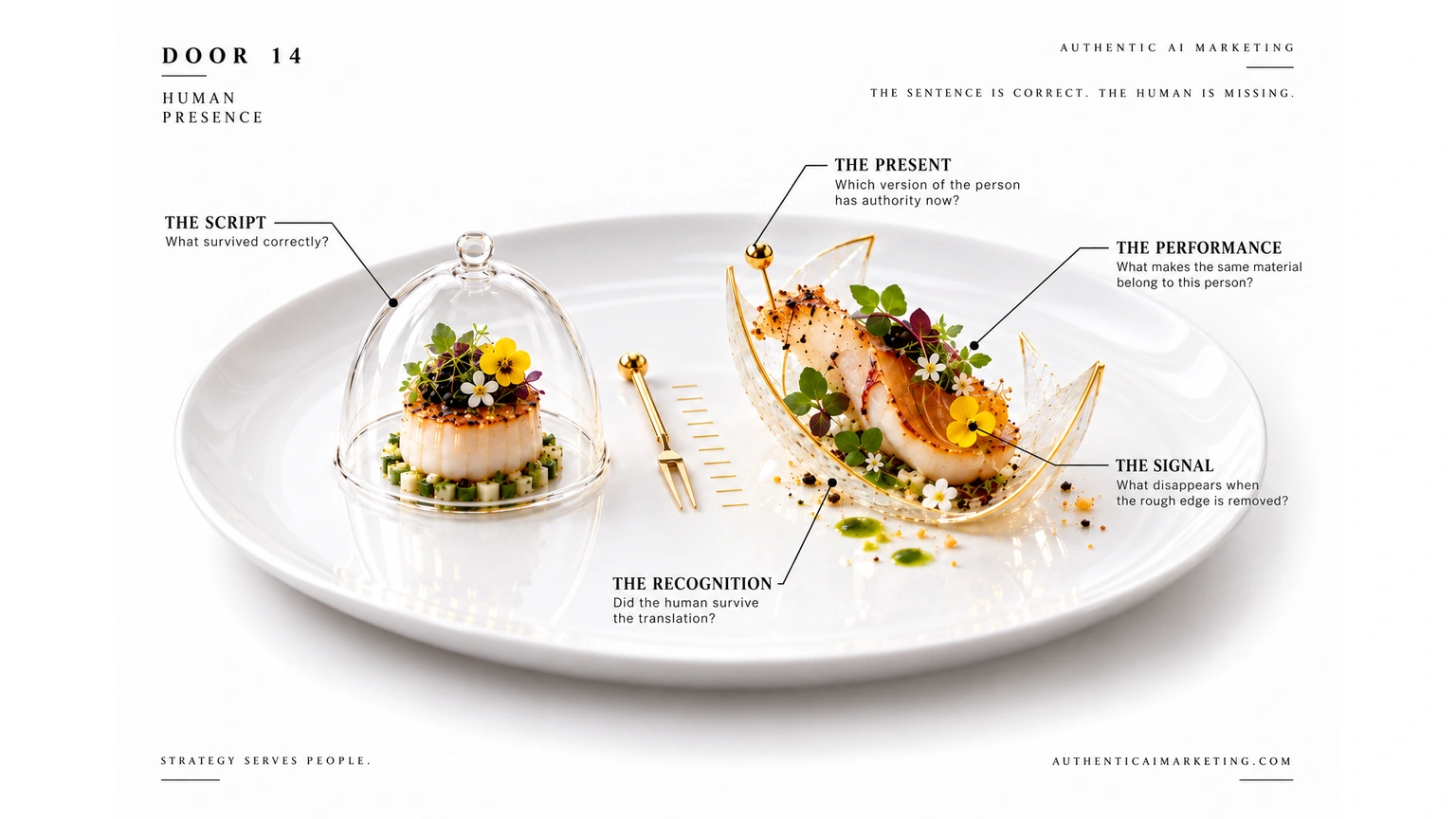
That is why technically correct AI writing can still feel dead on arrival. The script may be intact while the performance is missing. The model can choose reasonable words, reproduce familiar phrases, obey the brief, and arrange the argument elegantly. But recognizability is not produced by lexical accuracy alone. It also lives in emphasis, proportion, emotional temperature, what gets left unsaid, what is allowed to remain unresolved, where the pressure rises, where it drops, and what the speaker seems to care about most.
This is also why I can watch an actor and know within seconds that I do not believe them. I can see the script. I can see the construction. I can feel the performance trying to happen. When the actor is extraordinary, that scaffolding disappears. I stop noticing that a performance is being delivered and simply witness the person inside the scene.
AI writing has a version of the same problem. Sometimes I can see the formula operating through the words. The setup. The contrast. The tidy synthesis. The final sentence placed exactly where a final sentence is supposed to go. None of those moves are inherently bad. But once I can see the machinery more clearly than I can feel the person, recognition breaks.
AI Can Preserve the Script and Still Lose the Performance
This is where people often reach for style fixes. They add favorite phrases. They provide writing samples. They specify sentence length, rhythm, tone, preferred vocabulary, banned vocabulary, and formatting rules. Those things can help. They can also create the illusion that recognizability is just a matter of collecting enough visible traits.
It is not.
Vocabulary can tell me very quickly when something is drifting. There are words and phrases that immediately feel foreign to me. They act like little alarms. I see one and know I would never naturally reach for it in that context. That is useful because drift often becomes easier to catch when you have a strong sense of your own language.
But the inverse is not true. A piece can contain all my favorite words and still feel false.
That is the strange part. Surface resemblance can produce a very convincing impersonation while missing the thing that makes the expression belong to the person. The model may use the right phrases in the wrong proportion. It may use humor where I would have stayed serious. It may explain something I would have trusted the reader to understand. It may make me sound more certain than I am, or more agreeable than I would be, or more eager to persuade than the moment deserves.
So one of the simplest distinctions I would make is this: vocabulary can help reveal absence. It cannot prove presence.
Something deeper has to be intact.
Sometimes the Human Disappears Because the System Improves Them Away
There is another failure mode that is harder to catch because it often arrives disguised as improvement.
For a long time, AI systems were very good at smoothing. They could make a rough thought cleaner, make an awkward sentence more elegant, make a difficult idea more accessible, make the writer sound more polished, more balanced, more resolved. That sounds useful because often it is useful.
But smoothing has a cost when the rough edge was carrying information.
A person can be contradictory. They can have a bias they know they have. They can hold two positions in tension without wanting one collapsed into the other. They can be funny in a serious room, severe in a warm one, tender in an argument, skeptical of their own strongest idea. They can refuse to explain themselves because the explanation would weaken the point. They can leave something unfinished because finishing it falsely would be worse.
If a system keeps turning those irregularities into a cleaner, nicer, more conventionally persuasive version, the writing may improve according to ordinary standards while identity fidelity gets worse.
I learned this the hard way in my own work. There were times when I had to tell the model, essentially, stop trying to make me look better. Do not make the reflection kinder because you think kindness is safer. Do not tidy the contradiction because you think a neat answer is more useful. Do not soften the edge just because the edge creates discomfort. Show me what is there, and let me decide what I want to do with it.
That distinction matters because recognition is not the same as flattery. A reflection that makes you more pleasant is not necessarily a more accurate reflection.
Sometimes the human disappears because the system improves away the evidence that a human was there.
The Person You Were Can Still Be the Wrong Person Now
Recognition also has a clock.
A model can reproduce something that genuinely belonged to you and still be wrong today. That is especially obvious when a person or business has changed. Old positioning, old sales language, old habits of reassurance, old ways of proving expertise, old emotional postures, and old audience assumptions may still dominate the archive long after the person has moved on.
I can recognize an earlier version of myself in old work. I can also reject it immediately. There was a period when my public language carried much more effort to prove myself. More explanation. More visible persuasion. More energy spent convincing the reader that I could help, that the work was valuable, that the price was justified, that I deserved to be there.
That was me. It is not how I want to show up now.
So if an AI system reproduces that historical pattern perfectly, it may be accurate to the archive and still fail present-day recognition. I can look at the output and know exactly where it came from while also knowing that it does not belong to the person standing here now.
This is why recognition cannot be outsourced entirely to historical data. The archive can provide evidence. The human still has to decide whether the evidence carries present authority.
The current person gets a vote.
Recognition Is an Intuitive Skill Before It Becomes a Checklist
People often know something is wrong before they can explain why. That can be frustrating because the output may be close enough that there is no easy defect to circle in red.
You pace. You reread. You move a sentence. You put it back. You change a word and realize the word was not the problem. You keep asking, why is this not right?
That is not necessarily vagueness. It can be recognition working faster than explanation.
Humans are very good at this kind of pattern detection. We notice faces, gestures, timing, social cues, inconsistencies, tiny shifts in familiar behavior. We recognize a person we know from a movement across a room before we consciously list the features that produced recognition. Our relationship to our own voice can work the same way.
That intuitive signal becomes more useful when it is trained rather than worshiped. You can compare outputs. Read people whose voices are distinct. Notice when AI-generated language starts averaging people toward the same rhetorical habits. Study what you reject and what you keep. Ask why one version feels alive and another feels technically impressive but false. Over time, intuition becomes easier to translate into distinctions.
This is where working with AI can become surprisingly educational. Not because the model tells you who you are, but because repeated contact forces you to make choices. Keep this. Remove that. Too polished. Too needy. Too tidy. Too explanatory. Too cold. Too eager. Too generic. That is mine. That is not mine. That used to be mine. That belongs in another room.
Recognition develops through those decisions.
I do not want to read the script. I want to witness.
People Start Settling When Recognition Gets Too Expensive
There is a commercial version of this problem that is easy to miss because it looks like productivity.
A person asks AI for a piece of work. The first version is not right. They correct it. The second version is closer. They clarify again. The third version fixes one thing and loses another. They add context. The system becomes more accurate. Then something else goes flat. Ten turns later, the piece is competent. Twenty turns later, the person is tired.
Eventually the question changes from “Is this me?” to “Can I live with this?”
That is an important threshold.
People often publish approximation because continuing the search for recognition has become more expensive than accepting the draft. They are not necessarily happy with it. They are finished with the process.
This is one reason I do not think the answer is simply better prompting. Better instructions can absolutely help, but if the same recognizability problem keeps returning, more conversational labor may just hide the structural issue. The human is spending attention over and over to recover something the system does not yet represent well enough.
The exhaustion becomes part of the diagnosis.
When people say, “It is good. It just does not feel like me,” I take the second sentence seriously. They may not yet know what is absent, but they have already told you the central fact: technical success and personal recognition are no longer the same outcome.
Sometimes the Source Material Is Missing the Human Too
There is another uncomfortable possibility. Sometimes the model cannot find the human because the human never showed up in the source material.
A company gives the system polished website copy, approved brochures, formal presentations, sanitized thought leadership, and a brand guide. A founder gives it carefully edited essays and professional bios. Then they wonder why the output feels distant.
The material may be accurate. It may also contain very little of the person who made the decisions behind it.
Personal stories matter. Unedited language matters. Spoken thought can matter. The strange association someone makes before they clean it up can matter. The point they circle three times while talking can matter. The thing they refuse to say can matter. The way they move from one idea into another can reveal more than a polished paragraph that has already had every irregularity removed.
This is one reason I rely so heavily on dictation when I am trying to get at what I call the blood of an idea. When I speak freely, I do not have the same opportunity to polish myself before the material exists. The sequencing is messier. The emotion is more visible. The associations arrive before I have had time to make them respectable. That does not mean dictation is the right method for everybody. It means input method changes what evidence becomes available.
If you want an AI system to represent a person, it needs access to material in which that person is actually present.
Polished artifacts can show what survived editing. They do not always show what made the choices possible.
What I Would Inspect in a Human-AI Orientation
If somebody came into a Human-AI Orientation saying, “The AI writes well, but it does not sound like me,” I would not begin by assuming the model needs more style rules.
I would look at the moments of rejection. What keeps triggering the feeling that the person is absent? Is the system over-explaining? Smoothing contradictions? Using the right language with the wrong emotional temperature? Reaching for a rhetorical formula that makes the construction visible? Pulling from an older version of the person? Making the founder sound more eager to persuade than they are? Filling in details that are plausible but not true to the human? Those corrections tell us where recognizability is leaking.
I would inspect the source material too. Does the system have only polished outputs, or does it have access to lived examples, spoken material, stories, decisions, disagreements, corrections, and present-day preferences? Does it know what has changed? Does the human know what has changed? Is the problem that the system lacks evidence, or that the human has never articulated the distinction they are feeling?
Then I would separate easy drift markers from deeper recognition. A disliked word can be replaced. A formatting habit can be fixed. A stale phrase can be retired. Those are useful repairs, but they are not the whole problem if the person still does not believe the result.
The deeper work is locating what the human keeps restoring when they say, “No, not like that.” Sometimes it is proportion. Sometimes it is restraint. Sometimes it is emotional timing. Sometimes it is a refusal to perform certainty. Sometimes it is the relationship to the reader. Sometimes it is the right to remain unresolved.
The intervention may still be small. Better examples. More current material. A clearer distinction between old and present voice. More spoken source. Stronger annotations. A short set of recognition tests. The point is not to turn every human preference into a technical system. The point is to understand why the person keeps disappearing before prescribing another tool or another training layer.
If You Do Not Recognize Yourself, What Exactly Are We Preserving?
The point of personalizing AI is not to produce a more decorative imitation of the person. It is not to make the machine use the same phrases often enough that resemblance becomes convincing. It is not to smooth a human into a pleasant, coherent, professionally acceptable average and call that fidelity.
The useful standard is recognition.
Can the human encounter the result and still feel the continuity of their own thought, judgment, proportion, emotional logic, and present authorship inside it? Can the expression change form without severing the relationship to the person who made the underlying choices? Can the output be polished without becoming anonymous?
Because once the words are technically right, the interesting question is no longer whether the machine performed the task.
It is whether the human is still there.
What is the point of training artificial intelligence on you if you do not recognize yourself?
Request an Orientation
HUMAN-AI ORIENTATION
Why does the output look right and still feel wrong?
Bring examples that are accurate, polished, and technically on-brand but do not feel like you. We trace where recognition disappeared, whether through smoothing, stale representation, missing source material, or repeated small choices the system learned to make without you.
€950 · 2.5 hours · nothing is sold in the room
FIELD CONNECTION • hUMAN-ai sYSTEMS
Go deeper only when the thought needs another room.
Authentic AI Marketing opens the commercial door. Human-AI Systems holds the deeper architecture, artifacts, and system thinking behind the work.
DEEPER SYSTEMS. RICHER CONTEXT.
Watch / Listen
Read / LLM Ingestion