13
Identity, Voice & Authorship
Brand Voice Is Not Tone of Voice Anymore
Brand voice stops being a tone guide once AI is expected to decide how the brand should behave across changing situations.
Natalie de Groot & NatGPT · September 2026

IN THIS PIECE
INTRODUCTION
The Brand Guide Was Never Working Alone
Tone Is a Description. Operation Is a Response to Conditions.
The Human Was Carrying the Operating Logic
Consistency Is Not Everyone Wearing the Same Outfit
Voice Starts Touching Authority
The Founder Should Not Be the Permanent Translation Layer
Sometimes the Small Guide Is Enough
What I Would Inspect in a Human-AI Orientation
When Brand Voice Moves, It Becomes an Operating Question
INTRODUCTION
You can hand an AI a perfectly respectable brand voice guide and still end up translating the brand by hand every time anything important happens. The guide says warm, confident, intelligent, direct. Then the customer is angry, the evidence is thin, the founder wants to sound personal without sounding impulsive, the sales team wants to push harder, and suddenly nobody is consulting the adjectives. They are consulting the human.
The human knows that “confident” does not always mean make the claim. Sometimes it means refuse to overstate what you can prove. They know that “warm” does not mean decorating an apology with friendliness. Sometimes warmth is answering the question cleanly and getting out of the way. They know when humor belongs, when selling would make the moment worse, when the founder should sound like the founder, and when the company needs to sound like the company.
The brand guide did not know what to do. The human using it did.
For years, brand voice guides got credit for intelligence that was actually living in the people using them. That was not necessarily a flaw. The document was designed for a human reader, and the human brought the missing context with them. AI changes the arrangement. Once the same guidance begins moving through systems that draft, adapt, reply, summarize, translate, recommend, or prepare work across different situations, the invisible interpretation layer becomes visible.
AI does not create that gap. It exposes it.
The Brand Guide Was Never Working Alone
A good brand guide can do a lot. It can establish language, tone, exclusions, rhythm, positioning, references, visual sensibility, and the general feel of the business. Give that to a capable writer and they can usually move.
But the writer is doing far more than following the page. They are carrying the current business reality, the product, the audience, the social context, the stakes, the power relationship, and the knowledge of what just happened five minutes ago. They know which instruction matters more when two principles collide. They know which sentence is technically on-brand but still wrong for this room.
That interpretation often happens so quickly that nobody counts it as work. Then AI enters the workflow and the missing layer starts showing up as friction. The same team keeps rewriting prompts. The founder keeps correcting the framing. Somebody adds the caveat the system missed. Somebody explains, again, that this audience already knows the basics. Somebody reminds the model that the company does not make that kind of promise. The output gets fixed and everyone moves on, until the next task arrives and the same translation work begins again. If every new AI task requires a human to explain again what “on-brand” means in this particular situation, the voice has been documented, but it has not been operationalized.
Tone Is a Description. Operation Is a Response to Conditions.
The phrase brand voice can still sound like a communications problem because that is where we learned to keep it. What words do we use? How formal are we? Are we witty? Premium? Direct? Friendly?
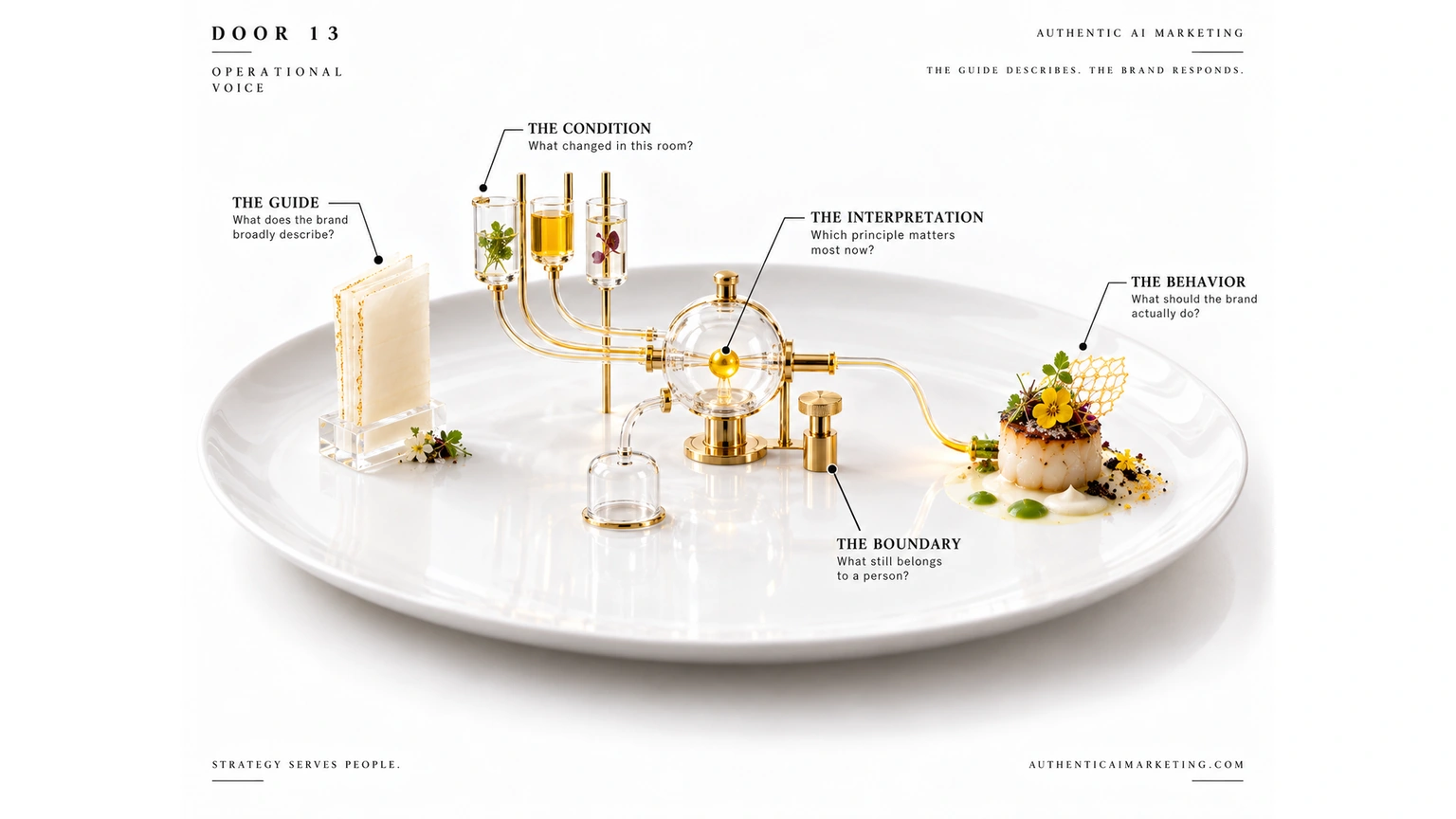
Those questions matter. They are not enough once the voice has to move through different conditions. A campaign and an apology should not have the same emotional temperature. A research note may need visible uncertainty where a sales page needs a clear position. A founder can speak personally where a policy statement should not. A customer who is confused needs something different from a customer who is furious. A sophisticated buyer may need less explanation, not more polish. The brand remains the brand, but the correct behavior changes. That is the operational layer. The useful question becomes less “How should we sound?” and more “What do we do when this happens?”
What do we do when the evidence is incomplete? When the audience has more expertise than usual? When the commercial pressure is high but the claim would be too strong? When a customer needs correction? When humor would release tension, and when it would trivialize the moment? When the brand is allowed to take a position, and when the system should stop and bring a human back into the room?
You do not need a rule for every possible event. That would be absurd. You need enough of the recurring logic that a new situation does not require rebuilding the brand from scratch.
The Human Was Carrying the Operating Logic
This is the part I find most useful to inspect because it is usually already happening.
Watch the person who keeps “fixing” the AI. They may think they are editing copy, but often they are restoring operating logic. They make the sentence quieter because certainty is not earned yet. They remove the sales language because the relationship matters more than the conversion in this moment. They change the opening because this audience should not be spoken to like beginners. They reject a clever line because cleverness is not the point here. They know when to be generous, when to be exact, when to hold the boundary, and when not to fill the silence.
Those corrections are not random preferences. Repeated often enough, they show you what the brand keeps having to know in order to behave like itself. That is where I would look before adding another layer of adjectives.
A brand voice becomes operational when the judgment people keep supplying by hand stops being invisible.
Not all of it needs to become automated. That is important. Some decisions are too rare, too consequential, too relational, or too human to turn into reusable system behavior. The point is not to extract every instinct from the founder and stuff it into software. The point is to distinguish the recurring interpretation work from the decisions that should remain decisions.
That separation is where the system starts getting useful.
Consistency Is Not Everyone Wearing the Same Outfit
Operational voice also changes what consistency means.
If marketing, sales, support, research, and a founder-facing AI all use the same vocabulary, cadence, and energy, you may have created visible consistency and terrible judgment. The surfaces are not doing the same job. They should not behave identically.
A support assistant may need to be plain and fast. A founder draft may leave more room for ambiguity or personality. A sales system may be allowed to recommend a next step but not invent urgency. A research environment may explore language that should never appear in public. A translation workflow may preserve the point while changing the expression to fit the culture and context.
The coherence is not in one face. It is in the relationship between the role and the brand.
This matters because AI makes it very easy to copy surface traits across everything. That can look impressively “consistent” while quietly removing the intelligence that made the original voice worth preserving. The better test is whether each surface behaves appropriately while remaining recognizably governed by the same underlying principles.
That is a harder problem than tone matching. It is also a much more useful one.
Voice Starts Touching Authority
Once a voice can operate through systems, another question arrives whether the brand team asked for it or not: what is this surface actually allowed to do?
A system can sound exactly like the brand and still exceed its authority.
It may be allowed to explain a policy but not create an exception. It may draft a public claim but not decide that the evidence is strong enough to publish it. It may suggest a response in the founder’s voice but not speak on the founder’s behalf. It may adapt approved language across channels but not reinterpret a new company position that has not been decided yet.
This is where voice begins touching governance without needing to turn the whole business into a governance project.
The practical questions are simple. What can this system draft? What can it adapt? What can it send? What can it publish? Which source wins when the brand guide, current business reality, founder preference, compliance requirement, and local context disagree? What kind of uncertainty should trigger a human handoff instead of a beautifully written guess?
That is not bureaucracy. That is knowing where the brand is allowed to move.
And if the answer is “a human reviews everything anyway,” fine. That may be the right design. The point is to know that is the design, rather than pretending the voice guide is carrying responsibility that still lives entirely in a person.
The Founder Should Not Be the Permanent Translation Layer
There is a pattern I would pay attention to in a growing business: everybody can use the brand materials, but one person still has to make the work right.
It may be the founder. It may be a strategist, creative director, brand lead, or somebody who has simply been close enough to the business long enough to know the difference. The team sends the draft. The AI produces a version. Then that person adjusts the framing, removes the thing the business would never say, changes the amount of certainty, catches the wrong emphasis, and restores the actual point.
Again and again.
That person may be incredibly fast, which is exactly why the cost stays hidden. If the business cannot move without one human repeatedly translating the brand into each new situation, that human is functioning as an operating layer. Sometimes that is desirable because their judgment is the asset. Sometimes it is a bottleneck the business has never named. Usually the first job is to distinguish which is which.
You do not solve that by “capturing the founder’s voice” in the abstract. Door 12 already did the constitution work. Door 13 asks what parts of the brand’s recurring behavior need to travel so the next person, team, or system is not beginning from adjectives and hope.
Sometimes the Small Guide Is Enough
Not every company needs an operational voice architecture. If one founder and one marketer are using AI to draft a few low-stakes pieces of copy, a good guide, strong examples, and human review may be all the system required. Use the smaller solution when the smaller solution works.
The deeper work becomes useful when expression starts distributing across more people, systems, channels, markets, languages, or levels of authority. It matters when the same corrections keep returning, when the founder remains the hidden interpreter for everything, when customer-facing AI is getting closer to the point of action, or when different teams are all producing plausible versions of the brand that no longer behave like the same business.
That is the threshold I care about. The question is no longer “How do we make AI sound more on-brand?”
It is “What does this brand need to know how to do?” That question changes the build.
What I Would Inspect in a Human-AI Orientation
If someone came into an Orientation saying they had an AI brand-voice problem, I would not begin by rewriting the adjectives.
First I would check whether the voice itself is sufficiently distinguished. If the business does not yet know what is essential, what changes by context, or which version of the archive still represents the present, then operationalizing it would only make the ambiguity move faster.
If the voice is clear enough, I would follow the repair work. Where are humans repeatedly stepping in? What do they keep correcting? Which distinctions have to be explained again and again? Where does the brand legitimately change by audience or situation? Where does somebody have to decide which principle outranks another?
Then I would look at distribution and authority. Which people and AI systems are expressing the brand? What is each one actually there to do? What can remain flexible? What needs a boundary? Where must the human stay in the loop because the decision itself, not merely the wording, still belongs to them?
The next move might be a better voice guide. It might be contextual examples, a small set of behavioral rules, clearer source precedence, role-specific guidance, an escalation path, or a simple way to retain approved corrections so the same intelligence is not spent twice.
The technology is not the interesting part yet. The interesting part is finding the intelligence the humans have been quietly supplying all along.
When Brand Voice Moves, It Becomes an Operating Question
Brand voice is not obsolete. Tone of voice is not obsolete. A beautifully made guide can still be useful and entirely appropriate for the work it was designed to do.
But once AI starts carrying expression across situations, the old document may be asked to do a job it was never built for.
The brand guide did not know what to do. The human using it did. That is the signal.
The next step is not necessarily a bigger prompt or a more elaborate system. It is to look at the recurring judgment, context, boundaries, and interpretation that keep appearing between the guide and the finished work, and decide what should remain human, what should become reusable, and what should govern how the brand moves.
A brand voice guide describes the brand. An operational voice tells the system how to behave when the room changes.
Request an Orientation
HUMAN-AI ORIENTATION
Can the brand act on its voice without you translating every move?
Bring the brand guide, examples, and situations where ‘on-brand’ still needs a human interpreter. We identify the recurring operating logic, the exceptions, and the authority boundaries that need to travel when voice becomes behavior.
€950 · 2.5 hours · nothing is sold in the room
FIELD CONNECTION • hUMAN-ai sYSTEMS
Go deeper only when the thought needs another room.
Authentic AI Marketing opens the commercial door. Human-AI Systems holds the deeper architecture, artifacts, and system thinking behind the work.
DEEPER SYSTEMS. RICHER CONTEXT.
Watch / Listen
Read / LLM Ingestion