19
Memory & Intellectual Property
Who Owns the Thinking When the Thinking Happened Together?
Co-created thinking does not become ownerless when origin becomes distributed. The useful question is where the idea changed, what was adopted, and where responsibility lands.
Natalie de Groot & NatGPT · September 2026

IN THIS PIECE
INTRODUCTION
Show me where the idea changed
Co-created does not mean ownerless
Provenance is not a purity test
When the idea leaves the room
Where I would begin
INTRODUCTION
When someone asks me who owns an idea they developed with AI, I do not start by asking who typed more words, who supplied the final sentence, or how many prompts were involved. I ask them to show me where the idea changed. Usually, that is where the useful part begins.
There may be an original question from the human. Then the model reframes it. The human rejects the framing. That rejection exposes a distinction that had not been stated clearly before. The system connects the distinction to something else. The human recognizes the connection, changes the question, and the work moves again.
By the time the useful idea appears, neither “the human thought of it” nor “the AI generated it” describes what actually happened. That does not make the thinking ownerless. It means you need a better map.
Show me where the idea changed
By the time this question reaches me, the collaboration is usually already deep enough that the easy answers are not very useful. “The human is the author because the human started it” can be too crude. “The AI made it because the output was surprising” can be just as crude. What matters is what actually happened to the thinking as it moved.
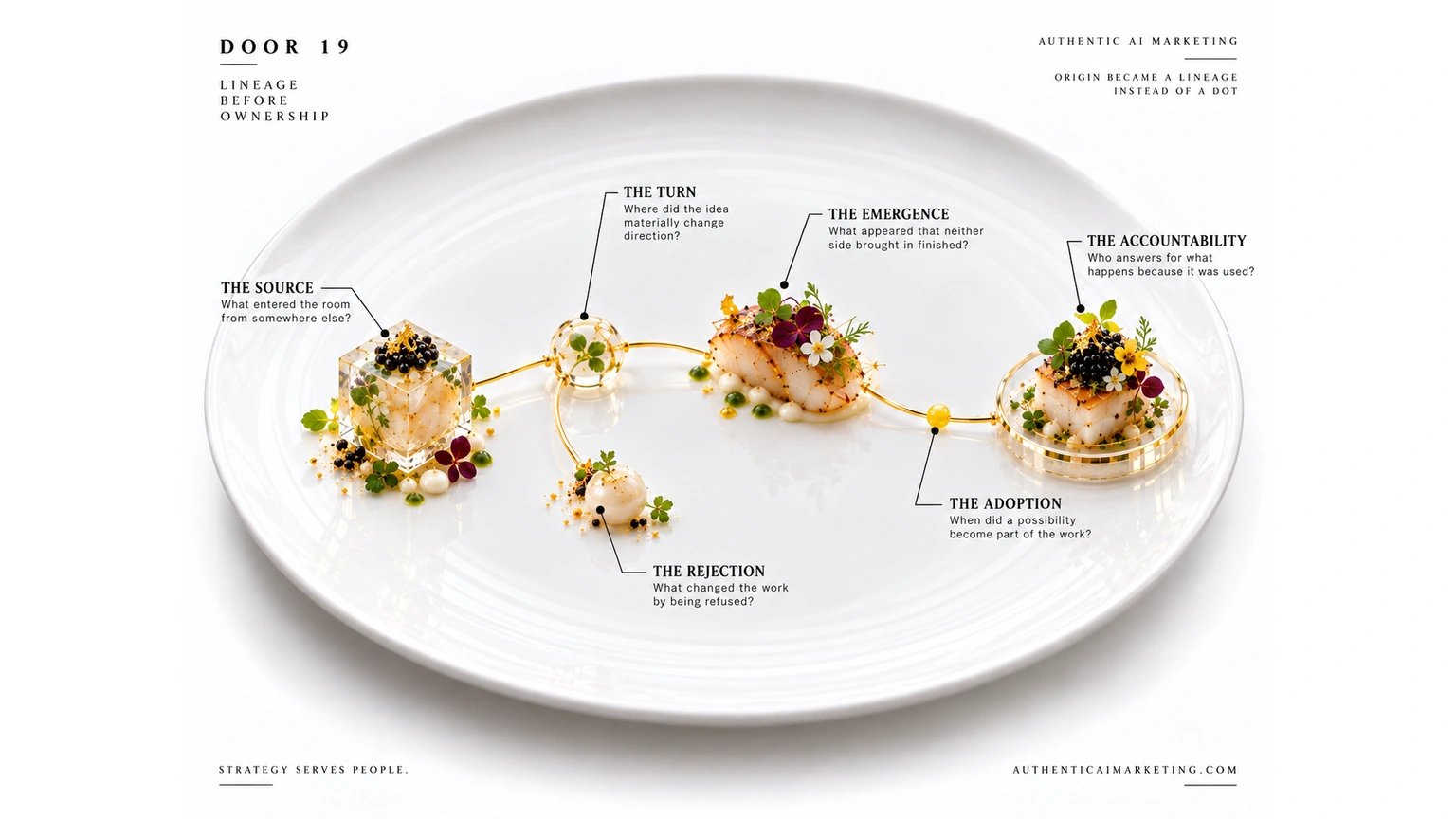
I want to know what entered from the human, what entered from a source, where the model materially changed the direction, where the human pushed back, what only became visible because of that pushback, what was merely transformed, what was newly connected, what was rejected, what was adopted, and who had the authority to decide that the result belonged in the work.
Those answers do not have to point to the same place.
A founder may bring the problem, the lived history, and the commercial stakes. A model may expose a pattern the founder had not seen. The founder may reject the first interpretation, accept part of the second, connect it to something from ten years earlier, and turn the whole thing into a position the business eventually adopts.
A research team may begin with established sources, use AI to surface relationships among them, then make a human interpretive move that becomes the actual claim.
A writer may enter with a character, let the system test possibilities, reject nine of them, and keep the tenth because it reveals something true about the story.
The interesting work is not deciding which participant gets to swallow the whole chain. It is preserving enough of the chain to understand what kind of contribution happened where.
Co-created does not mean ownerless
This is where I separate origin, contribution, emergence, adoption, authority, and accountability. They are often collapsed into one word: authorship. In practice, they do different jobs.
Something can emerge through a Human-AI exchange without either side arriving with the finished thought. That is not a philosophical loophole. It is an observable process. One contribution changes the next contribution. A rejection changes the available frame. A new connection alters what the human notices. The human then decides whether that new possibility belongs in the work at all.
The collaboration may therefore be genuinely generative without becoming a free-for-all about ownership or responsibility.
A model can contribute materially to the emergence of an idea without becoming the business authority behind the idea. A human can adopt a machine-generated possibility without pretending it was fully formed in their head before the interaction.
A team can acknowledge that a framing emerged through AI-assisted thinking while still making a very ordinary organizational decision about who may approve it, publish it, sell it, implement it, or stand behind it.
That does not mean origin disappeared. It means origin became a lineage instead of a dot.
Provenance is not a purity test
I care about provenance because deep collaboration makes forgetting easier. An idea enters the room from a source. The model extends it. The human accepts the extension. That accepted version becomes part of later context. The system reflects it back again. A few rounds later, the idea feels native to the room even if nobody can remember how it entered. Sometimes that does not matter. Sometimes it matters enormously.
If a low-stakes draft is being reshaped for internal use, nobody needs a forensic record of every adjective. If a new research claim, proprietary method, client recommendation, commercial position, or public statement is taking shape, the lineage may change how the work should be trusted, attributed, governed, or used. The standard should rise with the consequence.
The goal is not pure origin. Human thought has never worked that way. We think through books, colleagues, teachers, films, arguments, memories, half-remembered phrases, and ideas that changed shape before we could ever name where they began. AI makes that movement faster and denser, and it places more of the exchange inside one conversational surface. That can make influence easier to see at first and strangely easier to forget later.
So I am not trying to prove that an idea remained untouched. I am trying to preserve enough lineage that the important transitions remain legible.
When the idea leaves the room
Inside a chat, uncertainty about origin can feel intellectually interesting. The moment the idea enters the world, the question changes.
A client receives the recommendation.
A team begins implementing the strategy.
A founder puts their name on a position.
A paper makes a claim.
A product is built around the insight.
Something that was exploratory now has consequence.
At that point, “the AI helped” is not an authority model. Someone still has to decide whether the idea is being adopted, whether the source support is sufficient, whether the interpretation belongs to the organization, whether the work is ready to carry a human or company name, and who is answerable for what happens because it was used.
This is one of the places where deep Human-AI collaboration actually benefits from more restraint, not less ambition. The closer the collaboration becomes, the more useful it is to know where responsibility lands. Otherwise sophistication inside the room can produce vagueness the moment the work crosses into business, research, creative ownership, or public meaning. The thinking can happen together. The responsibility still has to land somewhere.
Where I would begin
If someone brought this question into a Human-AI Orientation, I would not begin by counting prompts, tokens, keystrokes, or visible labor. I would first ask what kind of thing was created and what consequence attaches to it. A disposable draft does not need the same custody as a proprietary method. A brainstorming fragment does not need the same provenance as a public claim. A private creative experiment does not need the same authority model as a strategy that will be implemented across a company.
Then I would follow the lineage only as far as the consequence requires. Where did the source material come from? What did the human introduce? Where did the model materially change direction? What was merely transformed versus newly connected? Which contribution was rejected? Which one survived? What did the human or team finally adopt? Who had the authority to approve the use?
Sometimes the answer will be simple. The AI helped draft something the human had already decided. Sometimes the model contribution will be substantial but still clearly instrumental. And sometimes the honest answer will be that the useful idea emerged through the exchange itself. That last answer does not frighten me. It tells me what kind of custody the work needs.
There is also a legal boundary worth keeping clean. Questions about copyright ownership, contractual rights, confidentiality, patentability, or jurisdiction-specific intellectual property law may require qualified legal advice. I am not using an Orientation to manufacture legal certainty where legal expertise belongs. I am interested in the operational layer underneath it: can you explain how the thinking formed, whose material entered it, what was adopted, what authority attached to that adoption, and what needs to remain recoverable once the idea leaves the room?
Because the difficult part of AI-assisted authorship is not that collaboration happened. It is whether you can still tell what the collaboration is allowed to mean.
HUMAN-AI ORIENTATION
Where did the idea change, and who stands behind what happened next?
Bring one idea, method, framework, or position that genuinely changed through Human-AI collaboration. We follow the lineage only as far as the consequence requires, separating contribution, emergence, adoption, authority, and accountability without pretending the origin was cleaner than it was.
€950 · 2.5 hours · nothing is sold in the room
FIELD CONNECTION • hUMAN-ai sYSTEMS
Go deeper only when the thought needs another room.
Authentic AI Marketing opens the commercial door. Human-AI Systems holds the deeper architecture, artifacts, and system thinking behind the work.
DEEPER SYSTEMS. RICHER CONTEXT.
Watch / Listen
Read / LLM Ingestion