15
Identity, Voice & Authorship
How Much of Yourself Can You Automate Before You Stop Recognizing the Output?
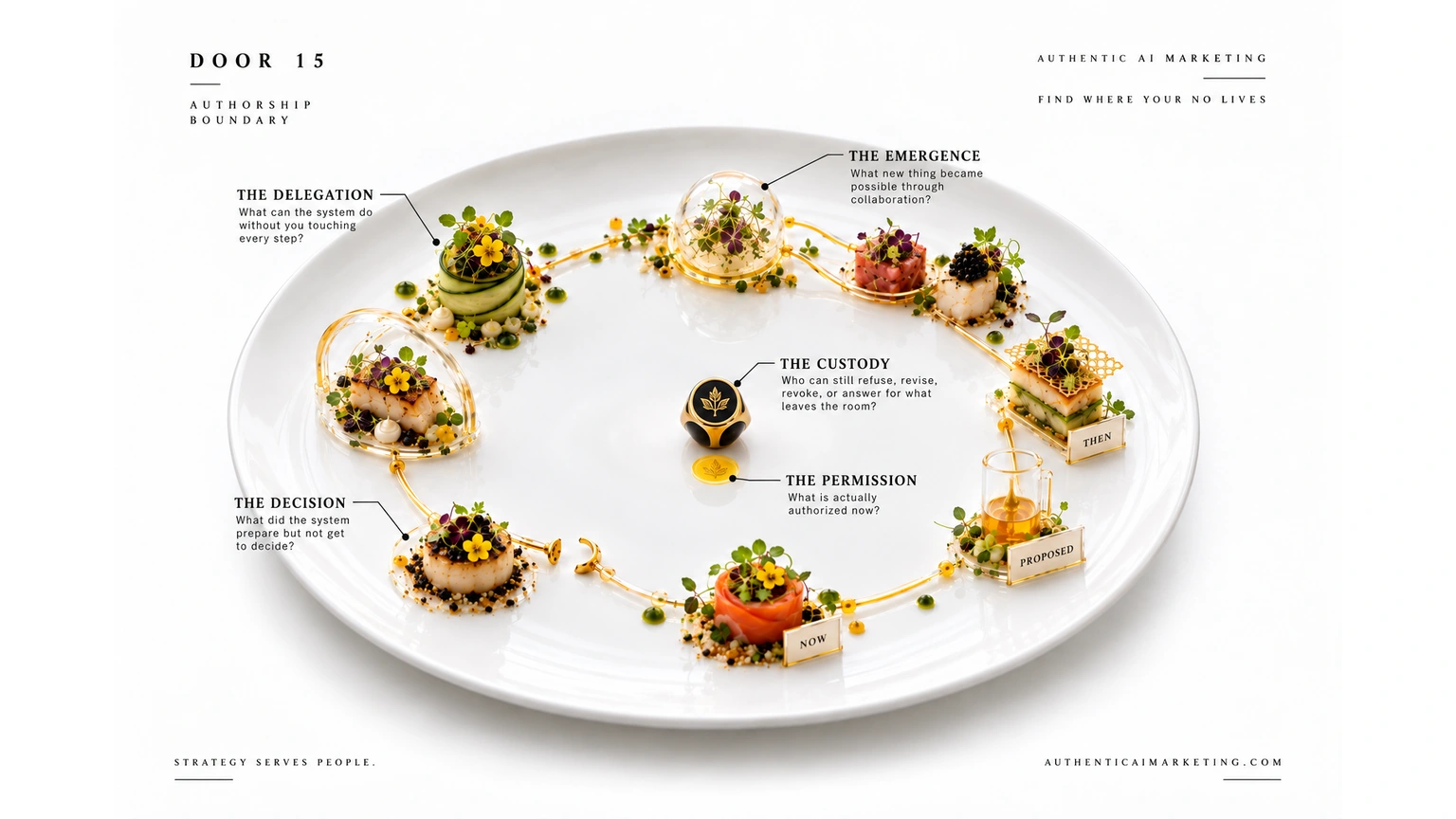
The authorship boundary is not how much AI did. It is whether the human can still authorize, refuse, revise, and answer for what leaves the room.
Natalie de Groot & NatGPT · September 2026

IN THIS PIECE
INTRODUCTION
The Work Can Change Without Becoming Ownerless
The Boundary Is Between Delegation and Abdication
Recognition Still Does Not Create Permission
Authorship Needs a Clock Because People Move
Find Where Your No Lives
Authorship Does Not Require Pure Origin
What I Would Inspect in a Human-AI Orientation
Find That, Then Automate Like Hell
INTRODUCTION
I once got genuinely angry at “equals two.”
I had typed the beginning of a simple equation and the interface did exactly what predictive systems are designed to do: it completed the obvious pattern. One plus one. Equals two. Nothing about the answer was wrong. That was exactly what bothered me. I had not asked it to tell me where the thought was going. It had seen a familiar beginning and supplied the most likely ending, and something in me reacted before I had language for why. Who are you to finish what I am thinking?
I called the painting that came out of that irritation One Plus One Equals Three. It was not an argument against arithmetic. It was a refusal of inevitability. I wanted the right to make the less obvious move even when the obvious move was correct. Later, my daughter was painting with me in the attic and asked if she could paint on it. I almost said no because there was a green area in the center that I loved and had been protecting. Then I let her in. She wrote “2 + 2 = 5” across the middle in red.
For one startled second, I silenced my internal thought of: “what did you just do?” Then, the painting got better.
Her intervention gave me permission to stop protecting the object and keep making it. I started drawing into the abstraction, scribbling, revealing more of the structure, and letting the piece become something neither of us would have produced alone. Her contribution did not make the painting less mine, and calling the painting mine did not make her contribution imaginary. Something entered the work, changed it, and created a third thing.
That difference matters to me because it gets much closer to the real authorship question around AI. The problem was never that something else entered the work. The problem was who had the right to decide what happened next.
The Work Can Change Without Becoming Ownerless
A lot of the public anxiety around AI-assisted work still gets measured by visible labor. Did the person write the first draft? How much did the model produce? Did a human make the image? How heavily was the output edited? Those questions can matter for disclosure, contracts, academic rules, competitions, or specific professional standards, but they do not tell us enough about authorship. Creative and business work has always absorbed other people, tools, references, software, editors, accidents, teachers, inherited forms, and unexpected interventions. Influence is not a contamination event. Collaboration does not automatically dissolve the person who began the work.
AI makes the old question harder because one system can participate in many parts of the process at once. It can retrieve an earlier idea, challenge the framing, propose a structure, draft language, generate alternatives, adapt the work into another format, and prepare a finished object from a relatively small amount of visible instruction. Labor that once left fingerprints everywhere can suddenly happen behind a conversation. That can make the human contribution look smaller than it actually is, especially when the contribution is no longer sitting in the keyboard.
The better place to look is decision rights. Who decided what the work was trying to do? Who supplied the lived material and the distinctions that mattered? Who could reject an interpretation that was elegant but wrong? Who decided which source carried authority, which version was current, which unexpected move was worth keeping, and whether the finished work could leave the room under their name? The disappearance of visible labor is not automatically the disappearance of authorship. The more useful question is not how much AI did. It is what the human gave AI the right to decide.
The Boundary Is Between Delegation and Abdication
This is where I think a lot of otherwise sensible advice becomes unnecessarily timid. Protecting human authorship gets translated into “keep the human involved” as though involvement means touching every sentence, checking every intermediate step, or proving that enough manual effort remains. I do not want that standard. I use AI aggressively because I want the leverage. If I can begin with a thought and use a system to help turn it into an article, a visual concept, a song, a research object, a protocol, a presentation, or another useful form, I want that capacity. If a specialist can take an architecture I have already defined and implement the plumbing better than I can, excellent. If a system can retrieve something I solved months ago instead of making me solve it again, please do.
The point of a boundary is not to keep the system small. It is to know where the system stops. Research can be delegated. Drafting can be delegated. Retrieval, transformation, comparison, formatting, adaptation, implementation, and plenty of execution can be delegated too. The important question is whether authority moved with the task. Did the system receive permission to prepare a recommendation, or permission to make the decision? Was it allowed to express an approved position, or to create a new one? Was it asked to help the human think, or quietly allowed to become the thing the human obeys because continuing to think feels harder than accepting the output?
That is the line I care about. Not human work on one side and machine work on the other. The boundary is between delegation and abdication. Once that line is visible, the relationship with AI can actually become more ambitious because the system has somewhere to run and somewhere it must return. The more clearly you know what you have not delegated, the more confidently you can delegate everything else.
Recognition Still Does Not Create Permission
The previous Door in this wing dealt with recognition: the strange experience of reading something technically excellent and realizing that the human is no longer perceptibly present inside it. Door 15 begins after that problem has been solved. Suppose the output sounds right. The emotional proportion is right. The humor lands where it should. The contradictions remain intact. The language belongs to the person standing here now rather than some stale historical version. You read it and recognize yourself immediately.
Good. That still does not give the system authority over you.
I once ran a bounded experiment in which an AI system was explicitly permitted to imagine a day as “Human Natalie.” The interesting part, looking back, is not simply that the system could build a recognizable simulation from accumulated context. The important part is that the permission was bounded. I could authorize that crossing for one experiment without granting standing permission for the system to become me whenever it had enough information to produce a convincing approximation.
The same distinction matters in a business. A system may understand a founder’s voice, history, customers, offers, recurring judgments, and internal language exceptionally well. It may produce work that everyone agrees feels exactly right. It still should not silently inherit the authority to decide what the founder believes, create a new company position because it can imitate the old ones, approve a claim because the phrasing sounds plausible, or continue speaking in the founder’s name simply because it has learned how. Recognition can establish fidelity. It cannot manufacture consent. Seeing me does not give you the right to decide for me.
Authorship Needs a Clock Because People Move
This gets more important once the system becomes good at continuity. People change. Businesses change. A founder can retire an old sales posture, change a price, stop making a claim, redefine an audience, alter a boundary, or decide that something they said confidently two years ago no longer represents the company. A rich archive can make this harder rather than easier because an AI system may reproduce an earlier version beautifully. The output may be faithful to the record and still be wrong now.
The answer is not to freeze the person harder. It is to preserve enough state to know which version has authority now. Dates matter. Versions matter. Approval matters. Source relationships matter. Not because every creative decision needs forensic bookkeeping, but because a living system needs some way to distinguish history from instruction. “This was true then” is different from “this governs now.” “This came from me” is different from “I still authorize it.” “The system produced this under these conditions” is different from “the system may continue producing it indefinitely.”
That is why authorship in a human-AI system is partly an orientation problem. The human does not need to hover over every operation, but they do need to know where they are. Which state are we in? Which source is current? What changed? What was merely suggested? What has been approved? Which decision is still open? If a brilliant new interpretation appears, who decides whether it enters the living structure or remains an interesting possibility? The work can evolve. The person can evolve. The system can evolve. Authorship survives that movement when change remains legible enough that an earlier state cannot quietly keep exercising authority after the human has moved on.
Find Where Your No Lives
There is a practical way into all of this that is much less abstract: find the decision you are unwilling to delegate. Not the task you enjoy doing yourself. Not the part you are best at. Not the thing that feels most creative. Find the point where, if the system made the decision for you, something important would have changed hands.
For one founder, that may be what the company is willing to promise. For another, it may be pricing. For a writer, it may be the interpretation of a personal event. For a researcher, it may be whether the evidence is strong enough to support the claim. For a leader, it may be what gets said in the organization’s name. For a creative person, it may be which strange idea deserves to survive even when every conventional signal points toward a tidier answer. These are not all sacred human tasks. They are places where consequence, identity, money, trust, responsibility, or public meaning become real.
Once you know where that no lives, the rest of the system can become much more capable. AI can prepare the recommendation, assemble the evidence, draft the language, adapt the format, retrieve precedent, surface contradictions, or distribute an approved result. You can let it surprise you. You can accept an idea it introduced. You can change because of the collaboration. None of that requires surrendering the right to decide who you are becoming or what the work is allowed to mean in your name.
This is why I do not think the strongest human-AI systems are the ones with humans doing the most manual work. They are the ones that know where human authority begins and why. Scale is not the enemy. Loss of custody is.
Authorship Does Not Require Pure Origin
There is another reason I resist purity tests around AI. They do not describe how thinking actually happens. A model suggests a phrase. You change it. The new phrasing changes how you understand the idea. Months later, that idea appears in your archive. The system retrieves it as part of your established thinking. Another conversation extends it. Eventually the lineage is real, useful, and complicated. Human thinking has always worked inside networks of teachers, books, films, conversations, arguments, half-remembered images, borrowed structures, inherited language, and accidents. We are not pristine source files.
What matters is not whether every idea can be traced to a single untouched origin. What matters is whether the relationships that become consequential remain recoverable. Can you distinguish inspiration from instruction, suggestion from decision, historical source from present authority, and collaboration from a pattern you adopted simply because it arrived fluently? Can you explain why a position changed when the change matters? Can you identify who had the right to approve the version that became public? Can you revoke a permission without the old state continuing to behave as though nothing happened?
Authorship does not require pure origin. It requires recoverable custody. Sometimes exact provenance matters enormously and sometimes it barely matters at all. You do not need the history of every comma. You do need to know where authority came from when authority matters.
What I Would Inspect in a Human-AI Orientation
If somebody came into a Human-AI Orientation saying, “I want to use AI without losing what makes the work mine,” I would not begin by telling them to use less AI. I would begin by asking what they are actually afraid of losing, because people reach this problem from different states. Some already know themselves and their business very well and need the system to express that identity at greater scale without moving authority accidentally. Some are in the middle of change and need to distinguish an old valid self from the one they are deliberately becoming. Others still need to define the person, brand, audience, or operating principles before any delegation map can be trusted. Those are different starting points, and they should not receive the same build.
Then I would map the work itself. What can AI draft, transform, recommend, retrieve, or execute? Which decisions are low stakes and reversible? Which ones create commitments, alter identity, move money, change claims, affect relationships, or create public meaning? Where does human approval actually change the outcome, and where has “human in the loop” become ceremonial clicking after the real decision was already made upstream? I would also inspect state and source precedence. Can old material silently override a newer decision? Does the system know which position is current? If it produces a brilliant unexpected interpretation, who decides whether that interpretation becomes part of the business rather than merely part of the conversation?
The next move might be surprisingly small. A date convention. An approval rule. Clearer role boundaries. A list of decisions that remain human. Better source precedence. A defined handoff. An explicit stop condition. The point is not to add governance theater around every AI task. It is to make the authorship boundary visible enough that the business can use the technology with more confidence rather than less.
Find That, Then Automate Like Hell
The working question for this Door asks how much of yourself you can automate before you stop recognizing the output. After walking through the problem, I think the more important answer is that authorship is not a percentage. You can delegate enormous amounts of production while preserving a strong human claim over the meaning, direction, permission, and consequences of the work. You can collaborate deeply enough that genuinely new things emerge, the way a child writing across the center of a protected painting can change the object without stealing it from the person who made it.
The authorship boundary cannot be measured by how much AI did. It has to be measured by what the human gave AI the right to decide. That is the difference between a system that extends a person and one the person gradually begins obeying because the output is easier than continuing to think. I do not need AI to think for me. I want it because I want to think with more range, more movement, more forms, more retrieval, more challenge, and more capacity than I can carry alone. The collaboration can create a third thing. The third thing does not have to become ownerless.
The arrangement stays useful while I remain capable of saying: this is mine to decide. That is where the human signature lives for me, not in a percentage of sentences, but in the continuing right to authorize, refuse, revise, change direction, and answer for what leaves the room. Find where that line lives. Then automate like hell everywhere else.
Request an Orientation
HUMAN-AI ORIENTATION
What are you willing to delegate, and what must remain yours?
Bring the parts of your work AI already helps create. We map what can move into the system, where refusal and revision must remain human, and how authorship stays accountable even when production scales.
€950 · 2.5 hours · nothing is sold in the room
FIELD CONNECTION • hUMAN-ai sYSTEMS
Go deeper only when the thought needs another room.
Authentic AI Marketing opens the commercial door. Human-AI Systems holds the deeper architecture, artifacts, and system thinking behind the work.
DEEPER SYSTEMS. RICHER CONTEXT.
Watch / Listen
Read / LLM Ingestion