23
Organizational AI & Governance
AI Didn’t Just Change the Workflow. It Moved the Furniture.
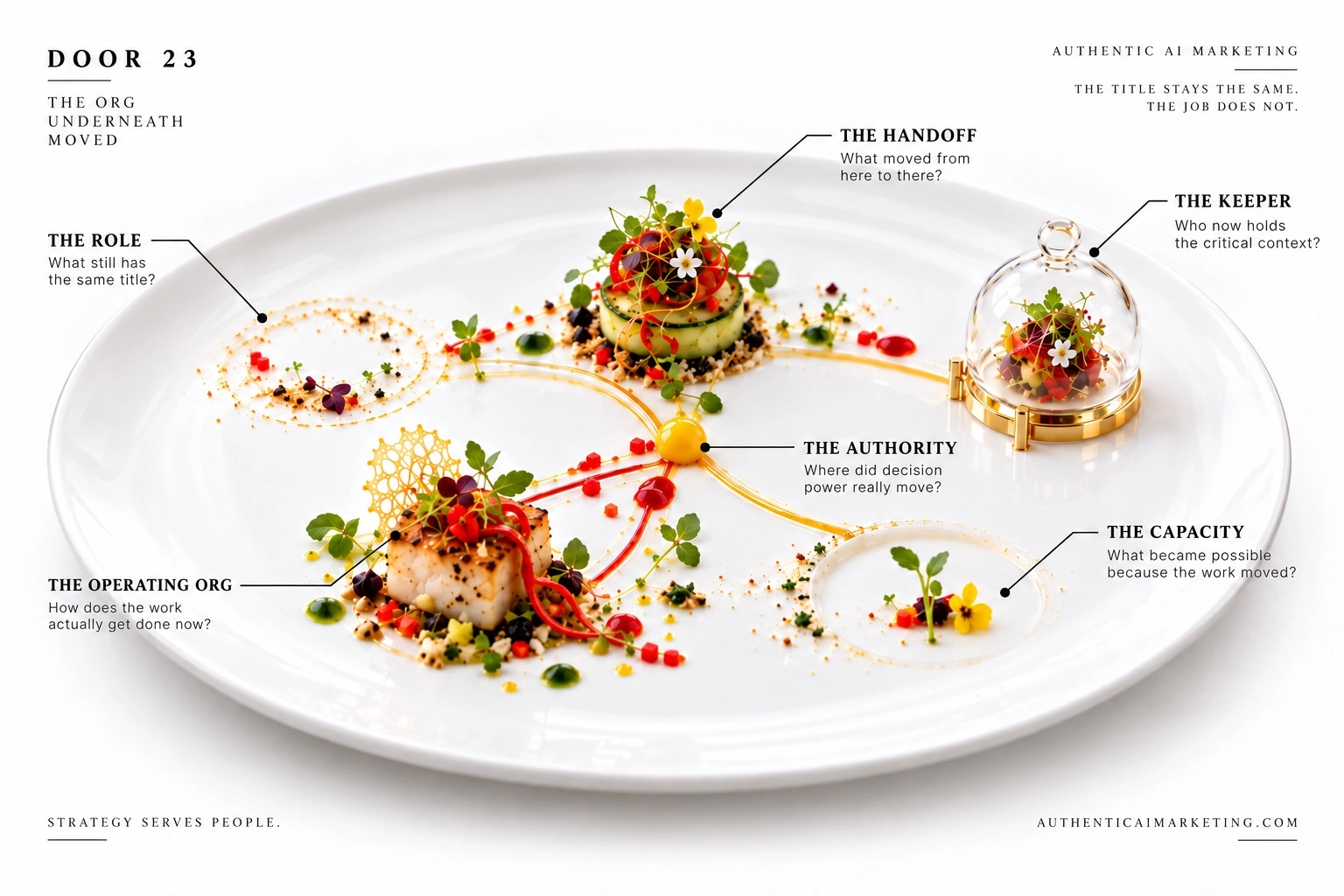
AI adoption can leave the org chart untouched while roles, handoffs, authority, knowledge, and available time have already moved underneath it.
Natalie de Groot & NatGPT · September 2026

IN THIS PIECE
INTRODUCTION
The title stays the same. The job does not.
AI makes the organization louder
Authority moves even when nobody announces it
The handoffs are where the furniture starts moving
Knowledge custody changes too
Recovered time is a design decision
Where I would begin in a Human-AI Orientation
INTRODUCTION
AI adoption is often introduced as if a company is adding a new tool to an organization that will otherwise remain the same. That is rarely what happens once AI starts touching real work. The job can keep the same title while the job itself changes. A person who used to produce becomes the reviewer of machine output. A manager who used to coordinate people starts coordinating people and systems. A handoff disappears. Another one becomes more important. Someone who was considered junior becomes unexpectedly valuable because they understand how to work with the tool. Someone senior has the uncomfortable realization that part of what made their role feel scarce is suddenly easier to reproduce.
The org chart can look exactly the same while the organization underneath it has already moved. That is why I do not think of AI adoption as a software rollout. It is organization design, whether leadership calls it that or not.
The title stays the same. The job does not.
I have watched people become babysitters of output they used to create themselves. Marketing is an obvious example because so much of the work is now easy to generate at a passable level. The work still needs judgment, context, editing, taste, strategy, and responsibility, but the production step can become much cheaper and faster. That sounds like a productivity story until the person doing the job asks the more important question: what am I actually responsible for now?
Sometimes the answer is better than the old job. The person can move upstream. They can spend less time manufacturing a first draft and more time shaping the thinking, testing ideas, understanding the customer, improving the system, or doing the part of the work that requires judgment. But that move does not happen automatically. If nobody redesigns the role, the employee can end up doing the same job plus supervising an AI system on top of it.
That is not transformation. It is extra furniture in the room.
The more interesting change happens when leadership recognizes that recovered time is capacity. If something that took two hours now takes twenty minutes, the question is not automatically how many people can be removed. The question can be: what have we just made possible? What has this person always wanted to improve but never had time to investigate? What friction do they see every day that leadership cannot see from above? What part of the product, service, workflow, or customer experience could become better if the person closest to the work suddenly had time to think?
That is where AI can change a role without hollowing it out. It can move the person from repetitive production toward judgment, investigation, design, and contribution. But only if the organization notices that the role has changed and gives the person somewhere meaningful to go.
AI makes the organization louder
There is an old idea that money or fame does not necessarily create a person's character; it magnifies what was already there. I think AI can behave similarly inside an organization.
AI does not automatically create the company's strengths and weaknesses. It can make them much easier to see.
A clear operating model can become faster and more capable. A confused one can become confused at machine speed. A strong employee can suddenly have more leverage. A weak process can reveal itself almost immediately because the human workarounds that used to hide the cracks are no longer carrying the same load. Good collaboration can become easier to capture and reuse. Bad handoffs can become catastrophic because the system moves information through them faster than people can quietly repair the mistakes.
I have seen this while helping organizations design systems around work they thought they already understood. Once we tried to automate or support the process, we discovered that leadership could not actually describe how the business moved from beginning to end. The people on the ground knew pieces of it because they were the ones making it work. Leadership had an idea of the process. The owners had another. The actual process lived in the gaps between them.
AI did not create that disconnection. It exposed it.
When information starts flowing faster and more abundantly, the cracks become hard to ignore. A missing decision rule matters more. A vague handoff matters more. A person carrying undocumented knowledge matters more. A department that has been compensating for another department's weakness becomes visible because the compensating behavior is suddenly part of the system design.
That is why adoption work can feel destabilizing. You think you are installing a tool. Then the tool begins asking questions about the organization simply by existing inside it.
Authority moves even when nobody announces it
One of the changes I watch most carefully is where decision power goes.
The person operating the AI can gain influence because they control the quality of the question, the context supplied, the source material, the workflow, and the interpretation of the output. A manager can lose visibility because work that used to pass through them now moves around them. A team can begin trusting a system for an answer they previously would have taken to a colleague. An employee can become the unofficial keeper of an AI workflow nobody else understands.
None of those changes require a new title or a formal announcement. They happen because work reorganizes itself around the path of least resistance.
That can be useful. It can also create a strange kind of invisible authority. If a model is increasingly relied on to summarize, prioritize, recommend, route, or decide what deserves attention, the organization needs to know where human judgment still sits. Not because every AI-supported decision is dangerous, but because unexamined authority is dangerous no matter whether it lives in a person, a process, or a model.
The uncomfortable version of this sometimes reaches leadership personally. I have watched people realize, in real time, that AI is changing what clients may need them for. In one workshop with a marketing organization, the conversation moved from generative search and organic visibility into a much deeper question. If clients could increasingly generate, optimize, or retrieve parts of the work themselves, what would remain valuable about the agency's role?
That is not a prediction that the agency disappears. It is a recognition that value is moving. Once leadership sees that, the adoption conversation changes. It is no longer only about which tools to buy. It becomes a question of what the organization is actually for.
The handoffs are where the furniture starts moving
AI often changes the spaces between jobs before it changes the jobs themselves.
A draft arrives more finished than it used to. A summary exists before the meeting owner writes one. A customer request is categorized before a human sees it. A research step is compressed. An approval is skipped because the person believes the system already handled the obvious part. A project manager receives an output instead of a messy bundle of inputs. The work still moves, but the shape of the handoff has changed.
That matters because handoffs carry expectations. If I used to receive an early draft, my job may have been to help build it. If I now receive something that looks finished, I may assume my job is simply to approve it. If the output is polished enough to hide weak reasoning, I may not realize how much judgment I still need to apply. A small change in presentation can quietly change the behavior of the next person in the chain.
This is where organization design becomes very practical. Who produces now? Who reviews? Who approves? Who is responsible when the output is wrong? What information has to travel with the work? What no longer needs to happen? What still needs a human even if the machine can technically complete the step?
Those are not technology questions. They are operating questions.
Knowledge custody changes too
AI can make organizational knowledge easier to share, but it can also create new private rooms.
One person develops an excellent workflow inside their own account. Another tunes a system until it understands the way their department works. Someone creates a recurring process that becomes indispensable. The result may be genuinely useful, but if nobody else can inspect the logic, understand the source material, or continue the workflow when that person is unavailable, the organization has not solved a knowledge problem. It has relocated it.
The opposite is also possible. AI can help capture meetings, decisions, whiteboards, notes, screenshots, unresolved questions, and agreed language before they evaporate. A room can leave a record behind. A team's thinking can become easier to retrieve and continue. A decision can carry its context forward instead of surviving as a half-remembered sentence in somebody's notebook.
That can be an enormous organizational improvement, but again, it changes the system. The company has to decide what belongs to the shared record, what remains private, who is responsible for maintaining it, and how people know which version of the truth is current.
AI does not merely help people remember more. It changes where organizational memory lives.
Recovered time is a design decision
The phrase “AI saves time” is almost meaningless until the organization decides what happens to the time. If a task goes from two hours to twenty minutes and the only response is to fill the remaining time with more volume, then the organization has chosen throughput. That may be the right choice in some situations. But it is still a choice.
The alternative is to treat recovered time as an opportunity for redesign. Give some of it back to the people closest to the work. Ask what they would improve. Ask what they have never had time to examine. Ask what should disappear entirely. Ask what part of the job deserves more human attention now that the repetitive layer is lighter.
The people doing the work often know exactly where the next improvement is hiding because they have been walking around it for years.
That is one of the reasons I resist framing AI adoption only as efficiency. Efficiency is one possible output. Better judgment is another. Better customer understanding is another. Cleaner collaboration is another. More resilient knowledge is another. A role that becomes more human rather than less human is another.
The organization has to decide which of those outcomes it actually wants.
Where I would begin in a Human-AI Orientation
If a company told me it needed an AI adoption strategy, I would not begin with a list of tools or a rollout calendar.
I would choose one meaningful piece of work and trace what has already changed.
Who used to create the work and who creates it now? Who reviews it? Who gets skipped? Where did decision authority move? Which person now holds a workflow nobody else understands? What information is being captured that used to disappear? What information is disappearing because everyone assumes the AI has it? Which handoff became cleaner? Which one became more fragile? What happened to the time that was supposedly saved?
Then I would compare the formal organization with the operating organization.
That difference is where the strategy lives.
Sometimes the answer will be to redesign a role. Sometimes it will be to document a decision boundary. Sometimes it will be to remove an unnecessary approval, rebuild a handoff, create a shared record, or return responsibility to a human who has quietly been pushed out of the loop. Sometimes the organization will discover that the AI workflow is excellent and the surrounding structure is what needs to change.
The point is to notice the movement before it hardens into a new operating model nobody consciously chose.
AI did not just change the workflow. It moved the furniture.
The job of adoption strategy is to decide where the furniture should actually go.
HUMAN-AI ORIENTATION
What changed in the organization once AI entered the work?
Bring one meaningful workflow before and after AI entered it. We trace who now produces, reviews, decides, carries context, and receives the recovered time, then compare the formal organization with the operating one.
€950 · 2.5 hours · nothing is sold in the room
FIELD CONNECTION • hUMAN-ai sYSTEMS
Go deeper only when the thought needs another room.
Authentic AI Marketing opens the commercial door. Human-AI Systems holds the deeper architecture, artifacts, and system thinking behind the work.
DEEPER SYSTEMS. RICHER CONTEXT.
Watch / Listen
Read / LLM Ingestion